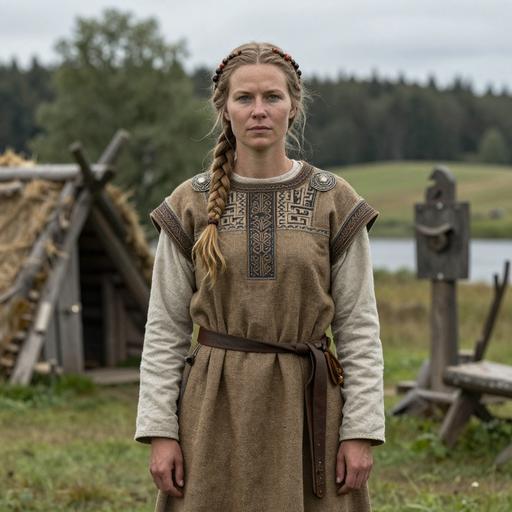
The Story
The journey of mtDNA haplogroup J1C3B
Origins and Evolution
mtDNA haplogroup J1C3B is a subclade of J1C3, itself a branch of the broader J1C lineage. The parent clade J1C3 most likely originated in the Near East/Caucasus region after the Last Glacial Maximum and spread with Neolithic and post‑glacial movements into Europe, the Mediterranean and North Africa. As a downstream offshoot, J1C3B probably arose several thousand years after the formation of J1C3, during the later Neolithic to Bronze Age interval (on the order of a few thousand years ago), reflecting further regional diversification within maternal lineages that were established in the Near East and adjacent regions.
Subclades (if applicable)
J1C3B is itself a defined terminal or near‑terminal clade within J1C3 in current phylogenies. Where sequenced, individuals assigned to J1C3B may form tight haplotype clusters consistent with relatively recent coalescence times compared with upstream nodes. As more complete mitochondrial genomes are sampled, J1C3B may be subdivided further; at present it is typically treated as a discrete subclade used to track regional maternal continuity and migration. Its immediate upstream clades (J1C3 and J1C) provide the broader phylogenetic context linking J1C3B to post‑glacial and Neolithic maternal expansions.
Geographical Distribution
The distribution of J1C3B is patchy but geographically coherent with the dispersal routes of J1C3. It is observed at low-to-moderate frequencies in the following broad regions:
- The Near East and Caucasus, where the parent lineage likely diversified and where J1C3B retains some of its highest relative frequencies.
- Southern Europe and the Mediterranean rim, including parts of Iberia, Italy and the Balkans, consistent with maritime and overland connections between the Near East and Europe during the Neolithic and later periods.
- North Africa, where contacts across the Mediterranean and trans‑Saharan and coastal networks have introduced Near Eastern maternal lineages.
- Central Asia and pockets of adjoining regions, reflecting historical dispersals and long‑range population movements.
J1C3B has also been reported in modern Jewish populations (both Ashkenazi and Sephardi contexts in some studies) and appears in at least five ancient DNA samples in archaeological datasets, indicating its presence in prehistoric and historic contexts.
Historical and Cultural Significance
Because J1C3B is a downstream derivative of a Near Eastern Neolithic-associated clade, its presence often marks maternal ancestry tied to the spread of agriculturalists and subsequent regional demographic events rather than very deep Paleolithic ancestry. In archaeological terms, its signals are most plausibly linked to:
- Neolithic farmer expansions and assimilation of local groups in the Mediterranean and Europe.
- Post‑Neolithic regional diversification during the Chalcolithic and Bronze Age, when many maternal lineages underwent further splitting and local founder effects.
- Historic-era mobility (trade, maritime contacts, and diasporas) that redistributed Near Eastern and Mediterranean maternal lineages into North Africa, Europe and within Jewish communities.
J1C3B itself is not typically associated with a single archaeological culture; rather it tracks a pattern of Near Eastern maternal ancestry that becomes embedded within many different cultural and genetic mosaics across time.
Conclusion
J1C3B is a useful marker for studying regional post‑glacial and post‑Neolithic maternal differentiation stemming from the Near East/Caucasus. Its low-to-moderate frequencies and appearances in both modern and ancient samples make it informative for reconstructing local demographic histories, maritime and overland connections in the Mediterranean and Near East, and the maternal component of diasporic populations such as Jewish groups. Future whole‑mitogenome sequencing and denser ancient DNA sampling will refine its internal structure and temporal depth.
Key Points
- Origins and Evolution
- Subclades (if applicable)
- Geographical Distribution
- Historical and Cultural Significance
- Conclusion