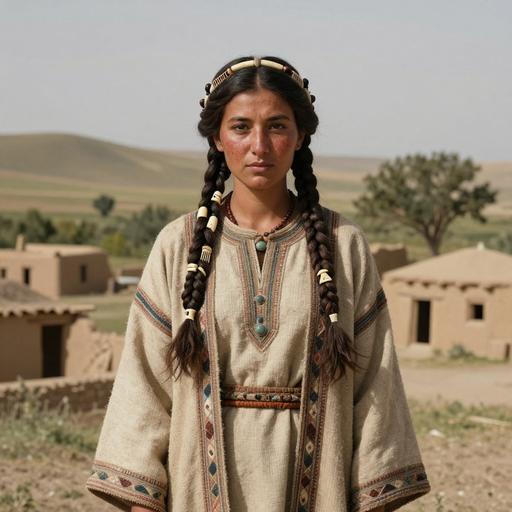
The Story
The journey of mtDNA haplogroup J2A1A1
Origins and Evolution
mtDNA haplogroup J2A1A1 is a downstream subclade of J2A1A, itself nested within haplogroup J2A and the broader haplogroup J phylogeny. Haplogroup J is broadly associated with post‑glacial and Neolithic expansions emanating from the Near East. Given the parent clade J2A1A is estimated to have originated in the Near East/Anatolia around the early post‑glacial to Neolithic interval (~7 kya), J2A1A1 most plausibly arose somewhat later, in the late Neolithic to early Bronze Age (we estimate ~5.5 kya). Its phylogenetic position and geographic distribution imply a Near Eastern/Anatolian origin with subsequent dispersal along Mediterranean and overland corridor routes.
Archaeogenetic evidence and modern population surveys show J2A1A1 occurs at low to moderate frequencies and tends to cluster in regions historically connected by Neolithic farming expansions, later Bronze Age movements and Mediterranean maritime contacts.
Subclades (if applicable)
As a terminal or near‑terminal branch in some published trees, J2A1A1 may include a small number of further downstream motifs in high‑resolution mitogenomes; however, it is commonly treated as a narrowly defined subclade beneath J2A1A in current phylogenies. Where deeper sequencing has been performed, micro‑subclades within J2A1A1 can reflect localized founder effects (for example in island or coastal communities). Continued full mitogenome sampling may reveal additional substructure linked to specific regional expansions.
Geographical Distribution
J2A1A1 is concentrated around the eastern and central Mediterranean with measurable presence in adjacent regions: southern Europe (coastal Italy, Greece, parts of Iberia), the Anatolian-Middle Eastern corridor, the Caucasus, and pockets in North Africa and Central Asia. Frequencies are typically low at the population level but notable where localized founder events or historical migrations (e.g., Phoenician, Greek, Roman, medieval trade and diasporas) amplified maternal lineages. This haplogroup also appears in some Jewish communities (Ashkenazi and Sephardi), consistent with Near Eastern maternal ancestry and later diasporic movements. In archaeogenetic datasets J2A1A1 has been identified in multiple contexts — our source database records 24 ancient DNA samples assigned to this clade, spanning Neolithic-to-Iron‑Age and later contexts in the Mediterranean and Near East.
Historical and Cultural Significance
The distribution and timing of J2A1A1 support a model in which the lineage was carried by Neolithic farmers expanding from Anatolia and the Levant into southeastern Europe and along Mediterranean coastal routes (Cardial/Impressed Ware and related maritime Neolithic networks). Later movements in the Bronze Age and Iron Age — including trade, colonization and population shifts around the Mediterranean basin — likely redistributed J2A1A1 at low frequencies to new coastal and island populations. The presence of J2A1A1 in some Jewish lineages reflects Near Eastern maternal ancestry maintained through historical continuity and diaspora. Local increases in frequency in particular sites or islands are plausibly due to founder effects, endogamy or demographic bottlenecks.
From a cultural‑historical perspective, J2A1A1 is therefore most informative as a marker of Near Eastern/Anatolian maternal ancestry that entered and persisted in Mediterranean and adjacent populations during and after the Neolithic transition.
Conclusion
J2A1A1 is a comparatively rare but geographically informative mtDNA subclade reflecting post‑glacial and Neolithic maternal connections between the Near East/Anatolia and the Mediterranean, with continued low‑level presence through the Bronze Age and later historical periods. It is best interpreted in combination with archaeological context, autosomal data and other uniparental markers to reconstruct precise population histories, especially where local founder events have shaped modern distributions.
Key Points
- Origins and Evolution
- Subclades (if applicable)
- Geographical Distribution
- Historical and Cultural Significance
- Conclusion