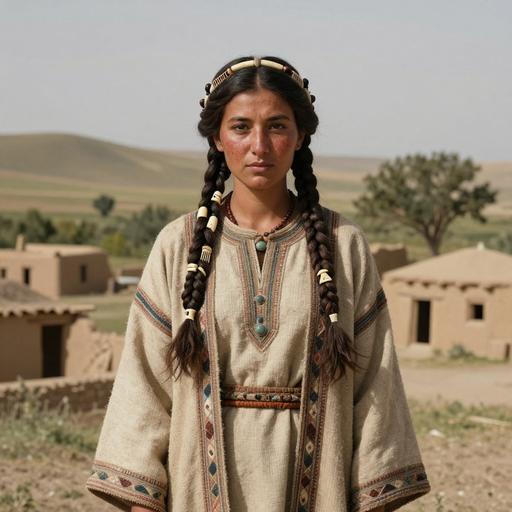
The Story
The journey of mtDNA haplogroup J2A2
Origins and Evolution
Haplogroup J2A2 is a downstream branch of mtDNA haplogroup J2a, itself part of mitochondrial macro-haplogroup J. J2a likely arises in the Near East during the Late Upper Paleolithic to early Holocene; J2A2, as a more derived lineage, probably diversified in the early Holocene (roughly ~12 kya) as human populations recolonized landscapes after the Last Glacial Maximum and as sedentary and proto‑agricultural societies developed. The phylogenetic position of J2A2 within J2a places it among lineages that have a Near Eastern provenance and a history of dispersal along Mediterranean and inland routes.
Subclades
J2A2 shows further internal branching in modern complete-mtDNA phylogenies; researchers report several downstream branches (often labelled as J2A2a, J2A2b, etc. in different sequence builds). These downstream clades can display subtle geographic structuring, with certain sublineages more common in particular regions (for example, some lineages enriched in southern Europe or the Caucasus). Ongoing revisions in mtDNA phylogenies mean assignment and nomenclature can change as more full mitogenomes are published.
Geographical Distribution
Modern population surveys and regionally focused studies indicate J2A2 is present at low-to-moderate frequencies in:
- Southern Europe (especially Mediterranean shorelines),
- The Near East (Anatolia, Levant),
- The Caucasus,
- North Africa (coastal areas),
- Some pockets in Central Asia,
- Jewish populations (seen in some Ashkenazi and Sephardi samples).
Frequencies are generally higher in zones connected historically to Near Eastern–Mediterranean gene flow and lower but detectable in more distant regions. J2A2 has also been identified in a small number of ancient DNA samples (four in the referenced database), confirming its presence in archaeological contexts and supporting continuity of some maternal lineages through the Holocene.
Historical and Cultural Significance
Because of its Near Eastern origin and distribution, J2A2 is most plausibly linked to early Holocene demographic changes, including post‑glacial re-expansion and the spread of food-producing populations into Europe and the Mediterranean during the Neolithic. In coastal and island contexts, maritime and coastal dispersal may have played roles in its spread. Later historical processes—Bronze Age movements, trade networks (including Phoenician and other Mediterranean maritime interactions), and historical diasporas such as Jewish migrations—help explain the patchy but widespread modern distribution. In many regions J2A2 remains a minor but informative maternal marker for tracing Near Eastern‑Mediterranean maternal ancestry.
Conclusion
J2A2 is a derived maternal lineage of Near Eastern origin that likely diversified in the early Holocene and entered Mediterranean, European, Caucasus and North African gene pools primarily through Neolithic and later historical dispersals. It typically occurs at low to moderate frequencies today but is useful in population and ancient DNA studies for reconstructing maternal connections across the Near East–Mediterranean world. Continued full mitogenome sampling will refine the internal structure, dating, and regional patterns of J2A2 subclades.
Key Points
- Origins and Evolution
- Subclades
- Geographical Distribution
- Historical and Cultural Significance
- Conclusion