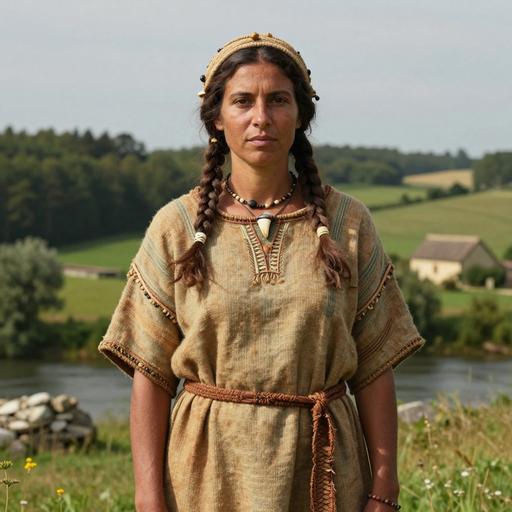
The Story
The journey of mtDNA haplogroup J2B1D
Origins and Evolution
mtDNA haplogroup J2B1D is a downstream subclade of J2B1 (itself part of haplogroup J2), a maternal lineage that has deep ties to Near Eastern and early Neolithic populations. Based on its position in the J2 phylogeny and the distribution of related lineages, J2B1D most likely arose in the Near East during the Holocene (several thousand years after the initial diversification of macro-haplogroup J). The estimated age for J2B1D is on the order of a few thousand years (we give a working estimate of ~6 kya), consistent with diversification events tied to local Neolithic expansions, coastal and maritime movements, and later regional demographic processes.
Subclades
As a relatively specific downstream branch (J2B1D), this lineage may contain a small number of further sublineages defined by private mutations observed in modern and ancient mitogenomes. Where high-resolution sequencing is available, researchers sometimes find geographically localized subclades within J2B1D that reflect founder effects on islands or in coastal communities. The substructure for J2B1D is still being refined as more whole mitogenomes and ancient DNA samples are reported.
Geographical Distribution
J2B1D is observed at low-to-moderate frequencies across the Mediterranean rim and adjacent regions. Modern occurrences are concentrated in Southern Europe (including Mediterranean islands), Anatolia and the Levant, parts of coastal North Africa, and the Caucasus, with sporadic reports in some Central Asian populations. The haplogroup also appears at low frequency in several Jewish communities (both Ashkenazi and Sephardi lineages have occasional carriers), reflecting long-term Near Eastern origins combined with later diaspora movements. In available ancient DNA datasets, J2B1/J2B1D-type lineages have been reported in a limited number of archaeological samples (6 relevant ancient samples in the referenced database), supporting continuity of this maternal lineage in Mediterranean and Near Eastern contexts from the Neolithic through later periods.
Historical and Cultural Significance
Because J2B1D is nested within a broader set of J2 maternal lineages associated with early farmers of the Near East, its distribution is compatible with Neolithic agricultural expansions into the Mediterranean and Europe. Coastal and island prevalence suggests that maritime mobility (Early Neolithic seafaring, later Bronze Age and Iron Age maritime trade, and historic-era movements such as Phoenician, Greek, Roman and later Mediterranean population flows) contributed to the spread and local persistence of this lineage. Its presence among some Jewish communities likely reflects ancestral Near Eastern matrilineal lineages that were carried into diasporic populations.
J2B1D is not typically a high-frequency marker of any single archaeological culture such as Bell Beaker or Corded Ware; instead it better reflects the genetic signature of early farmer-derived maternal ancestry and subsequent, often localized, founder events along Mediterranean coasts and islands.
Conclusion
mtDNA J2B1D is a regional, Near East–derived maternal lineage that illustrates how early Holocene and later coastal and cultural processes shaped Mediterranean and adjacent populations. It is best interpreted as part of the wider J2B1/J2 maternal signal associated with Neolithic demography and millennia of subsequent local migrations and exchanges. Continued whole-mitogenome sequencing and expanded ancient DNA sampling will refine the internal branching, age estimates, and more precise geographic origins of J2B1D and its sublineages.
Key Points
- Origins and Evolution
- Subclades
- Geographical Distribution
- Historical and Cultural Significance
- Conclusion