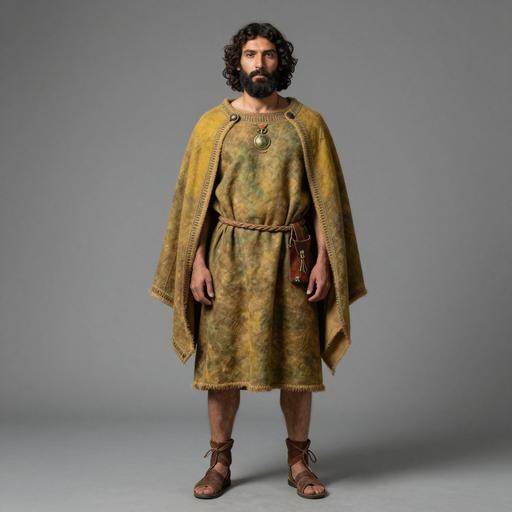
The Story
The journey of mtDNA haplogroup J2B1E
Origins and Evolution
mtDNA haplogroup J2B1E is a downstream subclade of J2B1, itself part of the broader J2B branch within macro-haplogroup J. Haplogroup J2B emerged in the Near East after the Last Glacial Maximum and diversified further during the early Holocene. As a sublineage of J2B1, J2B1E likely formed after the initial post-glacial population expansions, probably in the mid-to-late Holocene (several thousand years after the parent J2B1's estimated origin). Its phylogenetic position indicates it is a relatively derived maternal lineage that helps connect local modern populations to earlier Near Eastern and Mediterranean demographic events.
Subclades
At present, J2B1E is an intermediate terminal clade in many published trees and may include a small number of downstream branches defined by private or regionally restricted mutations. Because J2B1 and its sublineages have relatively low frequencies in most modern populations, deep sampling and full mitogenome sequencing are often required to resolve additional subclades. When additional whole-mitogenome data are obtained from Mediterranean, Near Eastern and Caucasus samples, further internal structure within J2B1E may be revealed.
Geographical Distribution
J2B1E is concentrated in regions historically connected by early Neolithic and later Mediterranean interactions. Modern and ancient DNA surveys indicate the clade is:
- Present at low-to-moderate frequencies in southern European populations, particularly around the central and eastern Mediterranean basin and on some Mediterranean islands.
- Found in the Near East (Anatolia, Levant), where its parent clades show higher diversity, consistent with a Near Eastern origin.
- Observed at low frequencies in parts of North Africa (coastal areas) and the Caucasus, reflecting gene flow across the Mediterranean and along Levantine-Caucasus corridors.
- Occasionally detected in Central Asian samples and in small percentages among some Jewish populations (both Ashkenazi and Sephardi), consistent with historical mobility and regional admixture.
The pattern of occurrence — broad but low frequency and slightly elevated diversity nearer the Near East — is consistent with origin in the Near East followed by expansions and episodic long-distance dispersal into adjacent regions.
Historical and Cultural Significance
Because J2B1E is nested within a maternal lineage commonly associated with early Holocene Near Eastern expansions, it is most plausibly linked to demographic processes such as the spread of agriculture and subsequent Mediterranean maritime and overland contacts. Specific cultural associations are inferred rather than direct:
- The greatest signal links J2B1E to Neolithic farmer expansions from Anatolia and the Levant into the Aegean and Mediterranean shores. These movements carried numerous J-clade maternal lineages into Europe.
- Later periods such as the Bronze Age and historical-era maritime trade and colonization (Phoenician, Greek, Roman) likely redistributed J2B1-derived lineages around the Mediterranean, contributing to its scattered presence on islands and coastal regions.
- The occurrence in some Jewish communities likely reflects the complex demographic history of those groups, which includes Near Eastern ancestry combined with local admixture in Europe and North Africa.
Conclusion
J2B1E is best understood as a derived maternal lineage with a Near Eastern genesis in the mid-to-late Holocene that subsequently spread into the Mediterranean, southern Europe, North Africa and the Caucasus at low-to-moderate frequencies. Its phylogeographic pattern fits models of Neolithic and post-Neolithic dispersal from the Near East with later admixture and localized persistence. Continued whole-mitogenome sequencing and denser ancient DNA sampling will improve resolution of J2B1E's internal structure and refine its temporal and geographic history.
Key Points
- Origins and Evolution
- Subclades
- Geographical Distribution
- Historical and Cultural Significance
- Conclusion