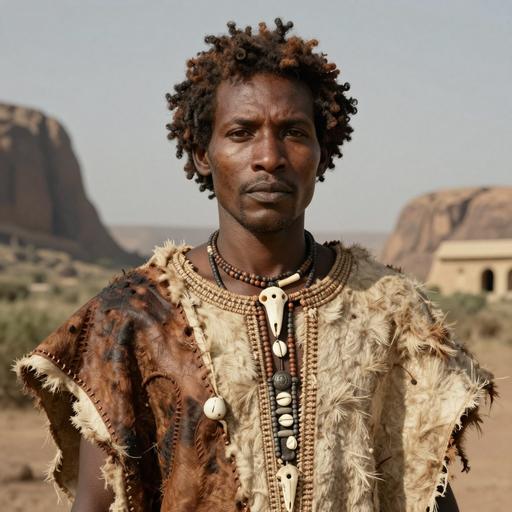
The Story
The journey of mtDNA haplogroup L0D1B2B1B
Origins and Evolution
mtDNA haplogroup L0D1B2B1B is a downstream subclade of L0d, one of the deepest mitochondrial lineages found in modern humans and especially concentrated among Khoe‑San forager populations of southern Africa. While the broader L0d lineage has very deep roots stretching well into the Late Pleistocene, the immediate parent clade L0D1B2B1 has been estimated to arise around ~15 kya in southern Africa; L0D1B2B1B represents a more recent bifurcation within that branch, plausibly originating during the early Holocene (we estimate on the order of ~7 kya). Its emergence likely reflects local differentiation within small, relatively isolated maternal gene pools characteristic of Khoe‑San and neighboring hunting‑foraging groups.
The phylogenetic position of L0D1B2B1B — a fine‑scale terminal branch under L0d — implies that its defining mutations accumulated after the main L0d diversification. Because L0d lineages have historically persisted in low‑density, highly structured populations, drift and founder effects have been strong forces shaping the frequency and geographic localization of derived subclades like L0D1B2B1B.
Subclades
At present L0D1B2B1B is a terminal/near‑terminal branch in published mtDNA phylogenies and population datasets; few or no widely recognized downstream subclades have been robustly defined in the literature. The scarcity of reported instances and limited sampling means additional fine structure may exist but remains uncharacterized until more complete mitochondrial genomes from relevant populations are sequenced. Its immediate parent, L0D1B2B1, contains the principal diversity from which L0D1B2B1B split.
Geographical Distribution
L0D1B2B1B is geographically concentrated in southern Africa, especially among Khoe‑San groups, where L0d diversity is highest. Outside those core populations it is observed at low frequencies in nearby Bantu‑speaking groups (reflecting historical gene flow and admixture), in some East and Central African populations at very low levels (reflecting ancient and historic contacts), and very rarely in African‑descended populations in the Americas because of transatlantic slave‑trade era admixture. A handful of isolated occurrences in North Africa and the Near East have been reported in contexts consistent with later historical movements and recent admixture, but these are exceptional.
Two ancient DNA hits in current archaeological databases include this lineage or its immediate relatives, indicating the clade has been present in prehistoric southern African contexts and is not solely a modern artifact.
Historical and Cultural Significance
Because L0d lineages are strongly associated with Khoe‑San populations, L0D1B2B1B acts as a genetic marker of maternal ancestry tied to southern African foraging lifeways and deep local continuity. Its presence at low frequencies in Bantu speakers and other neighboring groups documents historical gene flow between indigenous foragers and later incoming agricultural/pastoralist populations (including the Bantu expansions over the last ~2–3 kya and subsequent regional interactions). The persistence of such lineages into modern and ancient samples highlights both long‑term continuity of maternal lineages in southern Africa and the importance of demographic events (drift, local founder effects, and admixture) in shaping mtDNA diversity.
From a cultural perspective, L0D1B2B1B does not denote membership in a particular archaeological complex in the way Yamnaya or Bell Beaker might in Eurasia, but it is informative about the demographic history of Later Stone Age/Holocene forager groups and their contacts with arriving food producers and pastoralists.
Conclusion
L0D1B2B1B is a narrowly distributed, low‑frequency mtDNA subclade that reflects localized maternal differentiation within the broader L0d radiation of southern Africa. Its strongest modern association is with Khoe‑San forager populations, and its presence in neighboring groups underscores historical admixture and migration dynamics across southern, eastern, and central Africa. Greater sequencing of complete mtDNA genomes from under‑sampled populations and additional ancient DNA from southern African archaeological contexts will clarify its internal structure and precise time depth.
Key Points
- Origins and Evolution
- Subclades
- Geographical Distribution
- Historical and Cultural Significance
- Conclusion