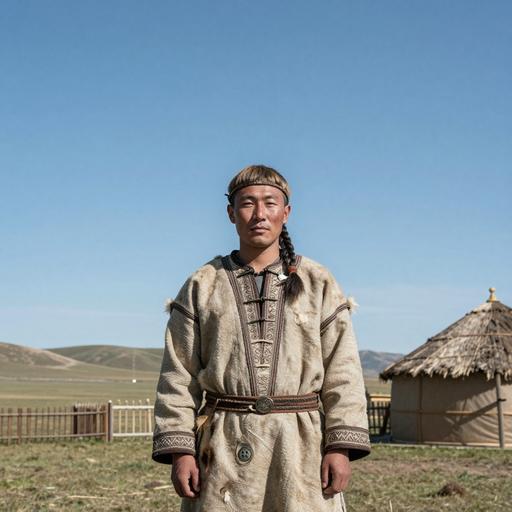
The Story
The journey of mtDNA haplogroup M11B
Origins and Evolution
mtDNA haplogroup M11B is a derived branch of macro-haplogroup M11, itself a lineage deep within macro-haplogroup M that expanded across East and Southeast Asia. Based on the phylogenetic position beneath M11 (whose coalescence is estimated near ~22 kya) and comparative molecular-clock estimates for similar subclades, M11B most likely arose in the Late Pleistocene to Early Holocene (a plausible coalescence around ~12 kya, though confidence is moderate and subject to refinement with additional complete-mtDNA sequences and calibration). M11B represents one of several regional offshoots of M11 that underwent local diversification following population separation and post-glacial range shifts.
Subclades
As a named subclade of M11, M11B may itself contain further internal diversity detectable only with high-resolution whole-mtGenome sequencing. Published studies and public mtDNA databases show a small number of private mutations marking M11B lineages; however, sampling remains sparse compared with more common East Asian haplogroups. Where data exist, M11B sequences cluster tightly, consistent with a localized expansion or long-term low-frequency persistence rather than a broad continent-wide radiation.
Geographical Distribution
M11B is principally an East Asian lineage with scattered presence in Southeast Asia. Modern observations place M11B predominantly among Han Chinese populations (both north and central China), Korean and Japanese samples (including insular/localized occurrences), and among some Tibeto-Burman and southern Chinese minority groups. Lower-frequency occurrences are reported in mainland Southeast Asian populations (Vietnamese, Thai, Lao) and in small numbers near northeastern Asian / Siberian border groups. Ancient DNA recovery of M11-related sequences has been limited but includes a few archaeological samples that confirm its presence in prehistoric East Eurasian contexts.
Historical and Cultural Significance
At the regional level, M11B contributes to the maternal genetic landscape of East Asia and reflects demographic processes such as post-glacial recolonization, localized continuity, and later Neolithic demographic shifts. M11B does not appear to be tied to a single pan-regional archaeological horizon; rather, its distribution suggests persistence in hunter-gatherer and early farming populations, and later incorporation into expanding agricultural communities. In Japan, some M11-lineage detections align with contexts associated with Jomon-period individuals or later admixture in island populations, while on the mainland traces of M11/M11B occur in populations linked to Neolithic and Bronze Age population transformations.
Conclusion
M11B is a modestly frequent, geographically focused maternal lineage derived from M11. It is most informative for regional studies of East Asian maternal ancestry where it can mark local continuity and micro-demographic events. Better resolution of M11B's internal structure and precise timing requires increased whole-mtGenome sampling from underrepresented East and Southeast Asian populations and integration with ancient DNA evidence.
Key Points
- Origins and Evolution
- Subclades
- Geographical Distribution
- Historical and Cultural Significance
- Conclusion