The Story
The journey of mtDNA haplogroup P5A1
Origins and Evolution
mtDNA haplogroup P5A1 is a subclade of P5A, itself a branch of the broader haplogroup P that is strongly associated with the Sahul region (New Guinea, Australia, and adjacent islands). Based on its phylogenetic position beneath P5A and comparisons of mutational divergence in modern sequences, P5A1 most likely coalesced in Near Oceania or adjacent Island Southeast Asia in the Late Pleistocene to early Holocene (roughly ~12 kya, with uncertainty). Its formation represents a regional diversification event after the initial settlement of Sahul and is best understood through phylogeographic patterns in contemporary indigenous populations and limited ancient DNA from the region.
Because ancient DNA coverage across Sahul remains sparse, estimates derive primarily from modern mtDNA complete-sequence phylogenies, molecular clock calibrations, and the geographical patterning of related P clades. That evidence supports a model in which P5A split from other P5/P lineages in Sahul, and P5A1 formed locally as populations remained largely regionally continuous through the Late Pleistocene and Holocene.
Subclades (if applicable)
At present, P5A1 is considered an intermediate-level clade beneath P5A. Published surveys and sequence databases indicate a small number of private mutations defining P5A1 and, in some cases, further downstream variants restricted to single islands or localized Papuan groups. The relative scarcity of P5A1 sequences compared with some other regional lineages suggests limited recent radiation; where further subclades exist they tend to be geographically restricted and of low frequency.
Geographical Distribution
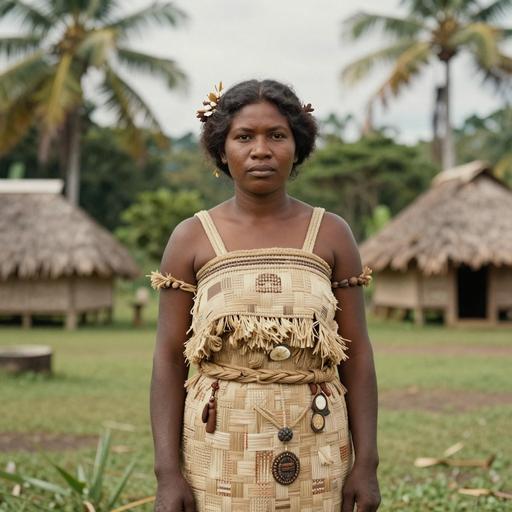
P5A1 shows a strongly regional distribution consistent with a Sahul-centered origin. It is most frequently observed among Papuan populations (both highland and coastal), present at moderate frequencies among some Indigenous Australian groups, and found at lower frequencies across Melanesia and Wallacea. Occasional low-frequency occurrences in eastern Indonesian islands and remote Oceanic populations reflect later mobility (island-hopping and Austronesian-mediated admixture) rather than widespread dispersal.
Geographically, the pattern is typical for maternal lineages that diversified in situ after the initial P/P5 expansions: deep local continuity in New Guinea and adjacent islands, with episodic low-level movement to neighboring islands during the Holocene.
Historical and Cultural Significance
The presence of P5A1 among Papuan and Aboriginal Australian groups reinforces the deep maternal continuity of Sahul populations dating back to the Late Pleistocene. P5A1 and related P lineages are informative markers for reconstructing early settlement, island-to-island gene flow, and the demographic impacts of later events such as the Austronesian expansion. While P5A1 itself does not mark a large-scale archaeological culture, its persistence through time provides genetic support for long-term population stability in many parts of Near Oceania and for localized female-line continuity despite subsequent cultural and linguistic changes.
During the Holocene, Austronesian movements and Lapita-associated dispersals brought new maternal lineages into parts of the region (e.g., B4a-derived lineages). Those events introduced admixture but generally did not erase deeply rooted Sahul haplogroups like P5A1; instead, P5A1 usually remained at low-to-moderate frequency where contact occurred.
Conclusion
P5A1 is a regionally restricted mtDNA lineage that reflects the complex demographic history of Sahul: an ancient origin within Near Oceania, continuity among Papuan and some Aboriginal Australian populations, and limited later spread into neighboring islands through low-frequency movements and Austronesian-era admixture. Further sampling of complete mitogenomes and any new ancient DNA from northern Australia, New Guinea, and Wallacea will refine its internal structure, age estimates, and finer-scale dispersal history.
Key Points
- Origins and Evolution
- Subclades (if applicable)
- Geographical Distribution
- Historical and Cultural Significance
- Conclusion