The Story
The journey of Y-DNA haplogroup O2A2A1A
Origins and Evolution
Haplogroup O2A2A1A is a subclade of the O2a (O‑M95) family and derives from the intermediate node O2A2A1. Based on its phylogenetic position and coalescent estimates for neighboring subclades, O2A2A1A most likely arose in Mainland Southeast Asia or adjacent southern China during the mid‑Holocene (roughly the last 3–4 kya). Its emergence fits a pattern seen across several O‑M95 sublineages that expanded with regional demographic processes such as the spread of wet‑rice agriculture, population growth, and language dispersals.
Population genetic surveys and targeted Y‑SNP typing place O2A2A1A primarily within populations historically and linguistically linked to Austroasiatic communities, with secondary presence in groups that experienced gene flow from those populations (for example, some Southeast Asian Tai‑Kadai, Tibeto‑Burman groups, and Austronesian‑speaking communities in maritime Southeast Asia). The clade is younger than the deeper O‑M95 radiation and appears to reflect local differentiation and demographic expansions in the mid‑to‑late Holocene.
Subclades
As a downstream branch of O2A2A1, O2A2A1A may itself contain further private SNPs and micro‑subclades detectable with high‑resolution sequencing or dense SNP panels. Published and unpublished datasets indicate internal structure in this branch, with some sublineages showing geographic localization (for instance, variants more common in Mainland Southeast Asia vs. those found among Munda groups in India). Continued sampling and sequencing of underrepresented populations will refine internal branching and the timing of subclade splits.
Geographical Distribution
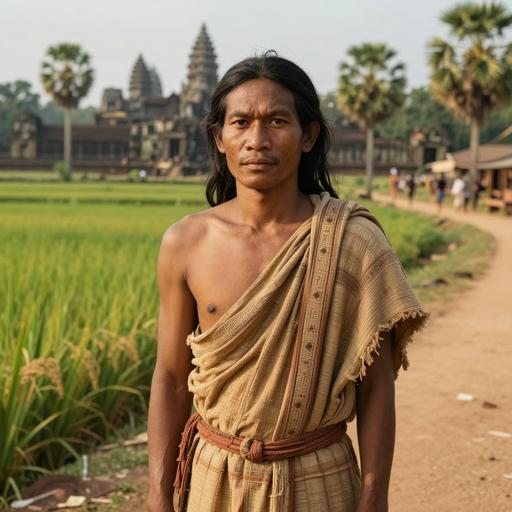
Geographically, O2A2A1A exhibits a core distribution in Mainland Southeast Asia and southern China, with notable frequencies among Austroasiatic‑speaking populations (e.g., Mon, Khmer, some Vietic and Khasi‑Khumic groups). It also appears among Munda‑speaking communities in eastern and central India at moderate frequencies, consistent with an inferred Holocene migration of Austroasiatic speakers into South Asia. Low to variable frequencies are detected in southern Han Chinese and some Austronesian populations in Island Southeast Asia and Taiwan, likely reflecting historical contact and gene flow rather than primary Neolithic Austronesian migrations. Sporadic occurrences are reported in Tibeto‑Burman and other neighboring groups where admixture brought in O‑M95 derivatives.
Historical and Cultural Significance
The distribution and age of O2A2A1A are consistent with an association to mid‑Holocene demographic processes such as the spread of rice cultivation and the regional expansion of Austroasiatic languages and cultures. Archaeological cultures in Mainland Southeast Asia that correspond temporally and spatially to these demographic shifts include late Neolithic to Bronze Age assemblages (e.g., farming communities represented in sites like Ban Chiang and later Dong Son cultural contexts in northern Indochina), which reflect agricultural intensification and increasing social complexity.
In South Asia the presence of O2A2A1A among Munda speakers supports genetic evidence for a Holocene intrusion from Southeast Asia into eastern/central India, carrying both autosomal and Y‑chromosome signals of Austroasiatic connection. In Island Southeast Asia and Taiwan the haplogroup's low frequency likely results from subsequent maritime interactions and admixture rather than representing a major founder lineage of Austronesian expansion.
Conclusion
O2A2A1A is a mid‑Holocene branch of the O‑M95 (O2a) family that documents regional male line continuity and movement associated with Austroasiatic populations and agricultural spread in Mainland Southeast Asia and secondary dispersals into South and Island Southeast Asia. It is best interpreted as a geographically informative marker for Holocene demographic processes in South and Southeast Asia, with ongoing refinement of its internal structure expected as more high‑resolution Y‑chromosome data becomes available.
Key Points
- Origins and Evolution
- Subclades
- Geographical Distribution
- Historical and Cultural Significance
- Conclusion