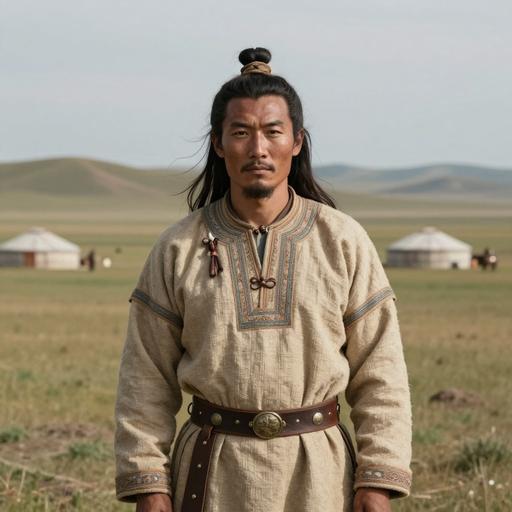
The Story
The journey of mtDNA haplogroup D4B2B2B
Origins and Evolution
mtDNA haplogroup D4B2B2B sits as a downstream branch of D4B2B2 within the broader D4 clade, a lineage with deep roots in northern and eastern Eurasia. Based on the phylogenetic position of D4B2B2B relative to its parent and sibling subclades, and consistent with coalescent estimates for nearby D4 sublineages, this subclade most likely arose in the early to mid-Holocene (~7 kya) along the North Pacific margin. Its emergence fits a pattern of localized diversification of maternal lineages among coastal and island-adapted populations after the Last Glacial Maximum, when ecological niches opened up along northeastern Asian shorelines.
Genetic drift and localized founder effects along maritime corridors (coastal Hokkaido, the Kuril–Okhotsk littoral, the Russian Far East and adjacent islands) likely drove the formation and relative enrichment of D4B2B2B in discrete populations. The branch's limited number of diagnostic mutations and its concentrated geographic range suggest a modest effective maternal founder size followed by preservation in demographically stable or semi-isolated groups.
Subclades (if applicable)
D4B2B2B is itself a downstream sub-branch of D4B2B2. At present, published and public-tree data indicate that D4B2B2B is a relatively narrow terminal subclade with few well-sampled downstream branches, consistent with its confined geographic and demographic history. The small number of identified ancient occurrences (two reported ancient samples in the user's database) and low-to-moderate modern frequencies limit resolution of internal branching; additional high-coverage mitogenomes from northeastern Asian archaeological contexts would likely reveal finer-scale structure within D4B2B2B.
Geographical Distribution
The modern distribution of D4B2B2B is concentrated in northeast Asia and the North Pacific rim. It is most frequently encountered in coastal and island groups of the Japanese archipelago (including Ainu-related lineages) and in indigenous Siberian and Russian Far East populations. Lower-frequency occurrences appear in broader East Asian populations (mainland Japanese, Korean, some Han Chinese), scattered groups in northern Mongolia, and occasionally in Mongolic and Turkic-speaking communities in Central Asia and in selected coastal Southeast Asian groups, likely reflecting historical gene flow and post-contact dispersals. Its confinement to northern coastal belts and island contexts supports an origin tied to maritime hunter-gatherer and early coastal-subsistence populations.
Historical and Cultural Significance
D4B2B2B's prominence among populations with documented Jomon- and Ainu-related ancestry makes it relevant for reconstructing the maternal lineages of pre-agricultural coastal northeastern Asia. The association with Jomon-associated ancient samples suggests continuity of at least some maternal lineages across the Holocene in the Japanese archipelago and adjacent areas. In later periods, incoming continental movements (for example, the Yayoi migration into Japan and various historical expansions across Northeast Asia) likely mixed D4B2B2B-bearing maternal lines into broader East Asian gene pools, explaining low-level occurrences among Koreans and Han Chinese in certain regions.
For indigenous Siberian and Russian Far East groups, presence of D4B2B2B fits broader patterns of maternal lineages that trace prehistoric coastal and riverine population histories, including mobility along the Amur, Okhotsk and Beringia-facing littoral corridors. Archaeogenetic recovery of D4B2B2B in ancient contexts (two samples in the referenced database) strengthens its interpretation as an autochthonous Holocene lineage rather than a modern recent introduction.
Conclusion
D4B2B2B is a geographically focused, Holocene-age maternal subclade of D4 that illuminates episodes of female-mediated continuity and local differentiation along the North Pacific margin. While currently low in overall frequency outside its core range, the haplogroup is a useful marker for studies of Jomon/Ainu-related ancestry, coastal-subsistence population histories in Northeast Asia, and the complex interactions between island/coastal groups and continental East Asian populations. Additional complete mitogenomes from archaeological and under-sampled modern populations will help refine its internal phylogeny and migration history.
Key Points
- Origins and Evolution
- Subclades (if applicable)
- Geographical Distribution
- Historical and Cultural Significance
- Conclusion