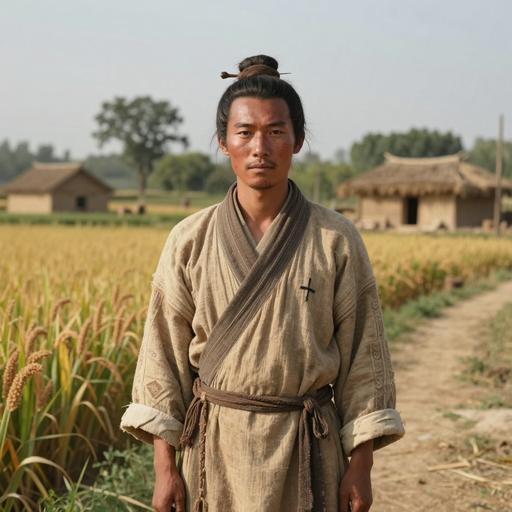
The Story
The journey of mtDNA haplogroup D4E1A
Origins and Evolution
mtDNA haplogroup D4E1A is a subclade of D4E1, itself part of the broader D4 phylogeny that is characteristic of East and Northeast Asian maternal lineages. Based on its position in the phylogenetic tree as a downstream branch of D4E1 and on population-genetic patterns seen for related D4 lineages, D4E1A most likely diversified in northeastern Eurasia during the early Holocene (postglacial), roughly around 7 kya (a reasonable working estimate). Its emergence represents a localized diversification event within a region that saw population continuity and local expansions after the Last Glacial Maximum.
Subclades
As a defined branch under D4E1, D4E1A may itself contain further internal diversity detectable with high-resolution complete-mtDNA sequencing. Published work on closely related D4 sublineages shows that many D4 branches split into geographically structured subclades (for example, Japanese-enriched vs. Siberian-enriched branches). Where present, deeply sampled mitogenomes help resolve internal nodes and date more recent expansions; at present D4E1A is best treated as a regional subclade whose finer substructure will become clearer as more mitogenomes from Northeast Asia and the Russian Far East are sequenced.
Geographical Distribution
D4E1A shows a distribution concentrated in Northeast Asia and adjoining Siberian and Japanese regions. Modern and ancient sampling indicates the highest frequencies and local enrichments in:
- Northeastern Japan (including populations with Jomon-related ancestry) and adjacent islands
- Indigenous Siberian groups and Russian Far East populations
- Mainstream East Asian populations (Han, Korean, Japanese) at lower to moderate frequencies
- Scattered, low-frequency occurrences in some Central and Southeast Asian populations, typically in coastal or contact zones
Two archaeological samples carrying D4E1A-level variation have been reported in public ancient-DNA databases, supporting continuity of this lineage in regional prehistories.
Historical and Cultural Significance
Because D4E1A sits within the suite of D4 lineages that are frequent among hunter-gatherer and early Holocene populations of Northeast Asia, its presence in ancient contexts can help track regional demographic patterns such as maritime hunter-gatherer persistence (e.g., Jomon-associated groups), postglacial recolonization of the Russian Far East, and later low-level gene flow into neighboring East and Central Asian groups. In modern populations, D4E1A contributes to the maternal diversity seen in Northeast Asia and can complement archaeological and autosomal evidence for continuity vs. migration in specific regions.
Conclusion
D4E1A is a geographically focused, early Holocene subclade of D4E1 that reflects postglacial diversification in Northeast/East Asia. Its detection in both modern and a small number of ancient samples ties it to longstanding maternal lineages of the region; continued mitogenome sequencing from Northeast Asia, the Russian Far East and ancient samples will refine its internal structure, age estimates, and the details of its historical dispersal.
Key Points
- Origins and Evolution
- Subclades
- Geographical Distribution
- Historical and Cultural Significance
- Conclusion