The Story
The journey of mtDNA haplogroup D4E1
Origins and Evolution
mtDNA haplogroup D4E1 is a downstream branch of D4E, itself a sublineage of the broadly distributed East Eurasian haplogroup D4. Based on the phylogenetic position of D4E within D4 and available ancient DNA evidence, D4E1 most likely diversified during the Late Glacial to early Holocene (roughly the terminal Pleistocene to early Holocene), after the Last Glacial Maximum when human groups in Northeast Asia began to re-expand and differentiate. The lineage is defined by derived variants within the D4E clade (coding-region and control-region mutations that distinguish it from sibling subclades); as with many mtDNA subclades, its internal structure and age estimates have been refined progressively as additional complete mitogenomes are sequenced.
Subclades
D4E1 can itself contain further internal branches (D4E1a, D4E1b, etc.) as more full mitogenomes are reported; these subbranches are often geographically localized. Where high-resolution sequencing has been done, researchers observe that subclades of D4E1 tend to show regional clustering (for example, enrichments in the Russian Far East, Hokkaido/northeastern Japan, or in specific Siberian groups), consistent with local founder effects and long-term maternal continuity.
Geographical Distribution
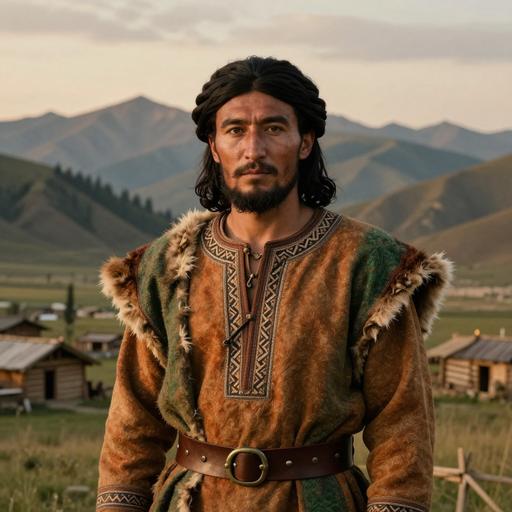
The highest frequencies and greatest diversity of D4E1 are found across Northeast Asia and the Russian Far East, with clear representation in modern populations of northern Japan, Korea, Han Chinese in northeastern provinces, and multiple indigenous Siberian groups. Lower-frequency occurrences are documented in some Mongolic- and Turkic-speaking groups of Central Asia and scattered coastal or northern populations of Southeast Asia, likely reflecting historic gene flow and maritime interactions. Ancient DNA finds (including Jomon and other archaeological contexts) show the lineage has been present in the region for several millennia, supporting both deep local roots and episodes of demographic stability.
Historical and Cultural Significance
D4E1's distribution connects it to populations and archaeological contexts that shaped the prehistoric peopling of Northeast Asia. Its presence in Jomon-era samples and in ancient Siberian remains ties D4E1 to hunter-gatherer groups of the late Pleistocene and early Holocene whose descendants contributed to the genetic makeup of modern Northeast Asian peoples. Localized enrichments of D4E1 in island and coastal populations point to demographic processes such as founder effects, bottlenecks, and limited maternal-line continuity in semi-isolated communities (for example, Hokkaido and the Russian Far East). Occasional low-frequency occurrences farther afield (Central and Southeast Asia) reflect later migrations, trade networks, and admixture events rather than primary centers of origin.
Research Notes and Ancient DNA
D4E1 has been recovered in multiple ancient DNA contexts (the dataset referenced here lists nine ancient samples). Those ancient occurrences help anchor the clade to the region and timeframe described above and provide evidence for continuity between ancient hunter-gatherers (including Jomon-related groups) and some modern Northeast Asian populations. As mitogenome sampling expands across Siberia, northern China, Korea, and Japan, the topology and age estimates for D4E1 will become more precise.
Conclusion
Overall, D4E1 is a regionally important maternal lineage of Northeast/East Asia that exemplifies post-Last Glacial diversification in this part of the world. Its pattern of concentrated presence in Siberia, the Russian Far East, northern Japan, Korea, and northeastern China—combined with occasional peripheral occurrences—supports a model of early Holocene origin followed by local persistence, drift-driven differentiation, and limited long-range dispersals associated with later historic contact and migration.
Key Points
- Origins and Evolution
- Subclades
- Geographical Distribution
- Historical and Cultural Significance
- Research Notes and Ancient DNA