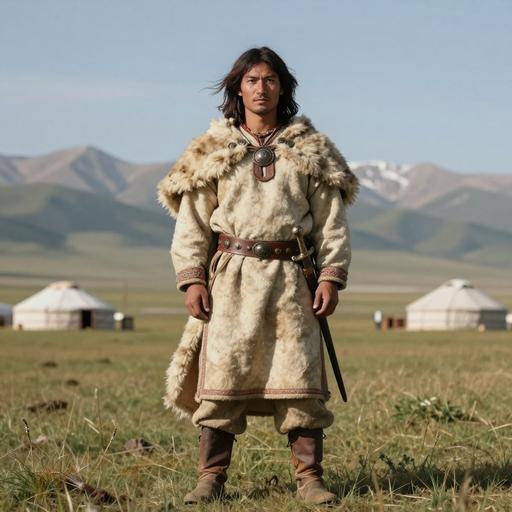
The Story
The journey of mtDNA haplogroup D6A2
Origins and Evolution
mtDNA haplogroup D6A2 is a subclade of D6A, itself part of the broader East Eurasian D6 lineage. As a downstream branch, D6A2 likely diversified after the initial formation of D6A in the early Holocene. The parent lineage D6A has been dated to roughly ~12 kya in Northeast Asia; D6A2's internal coalescence is plausibly younger (on the order of several thousand years later), consistent with localized expansions and founder effects in the Holocene rather than a deep Pleistocene origin.
Phylogenetically, D6A2 shares the characteristic mutations that define the D6A branch and carries additional derived variants that mark its separation from sister subclades (e.g., D6A1, D6A3). Its pattern—low-to-moderate, geographically patchy frequencies—is typical for many East Eurasian subclades that spread with small-scale demographic events (localized migrations, founder lineages, and postglacial recolonization) rather than continent-wide expansions.
Subclades
D6A2 itself may contain further internal diversity detectable with full mitogenome sequencing, but published and database evidence indicates only a few defined downstream lineages at present; many carriers are identified by control-region or partial-sequence matches. Related subclades within the D6A branch include D6A1 and D6A3, which together represent a small radiation of D6A lineages across Northeast and adjacent regions. Continued complete-mtDNA sampling in underrepresented populations (Siberian, Central Asian, and some South/Southeast Asian groups) is likely to reveal finer sub-structure within D6A2.
Geographical Distribution
Empirical detections of D6A2 are sparse and patchy, consistent with a history of small-scale dispersals and founder events. Reported occurrences (modern and ancient) cluster in:
- Northeast and East Asia: sporadic occurrences among Chinese, Korean and Japanese populations, and indigenous groups in the Russian Far East. Coastal and inland forager populations of the early Holocene are plausible sources for some lineages.
- Siberia and Russian Far East: low-frequency detections among indigenous Siberian groups reflecting northward and eastward gene flow.
- Central Asia: isolated detections in populations such as Kazakh and other Central Asian groups, likely reflecting historic long-distance gene flow and contact networks.
- South and Southeast Asia: occasional presence in northeastern Indian/Tibeto-Burman-speaking groups and sporadic detections in mainland Southeast Asian populations (Thailand, Vietnam, Malay-speaking groups), consistent with secondary dispersals or small founder events.
D6A2 has also been identified in a small number of archaeological samples from Holocene contexts, which corroborates its presence in prehistoric Northeast Asian and adjacent populations.
Historical and Cultural Significance
Because D6A2 is neither extremely frequent nor geographically widespread, its cultural associations are best framed as localized rather than pan-regional. The lineage is compatible with scenarios of postglacial re-expansion of Northeast Asian maternal lineages, coastal-forager persistence, and later interactions with farming and pastoralist groups.
Archaeologically relevant contexts where D6A-type lineages (including D6A2) have been reported or are plausible include Jomon-period and other early Holocene coastal-forager groups in Japan and the Russian Far East, and later Holocene assemblages in northeastern Asia. In historic and ethnographic times, traces of D6A2 in Central and South Asian populations likely reflect millennia of low-level gene flow along trade and migration routes rather than large-scale demic replacement.
Conclusion
D6A2 is a Holocene-aged Northeast Asian-derived mitochondrial subclade characterized by low, patchy modern frequencies and occasional detection in ancient samples. Its distribution reflects the complex mosaic of Holocene maternal lineages in East and adjacent regions—driven by postglacial expansions, coastal and inland dispersal, and localized founder events—rather than a single dramatic demographic event. Increased whole-mitogenome sampling in underrepresented regions will help clarify its internal diversity and finer-scale prehistoric movements.
Key Points
- Origins and Evolution
- Subclades
- Geographical Distribution
- Historical and Cultural Significance
- Conclusion