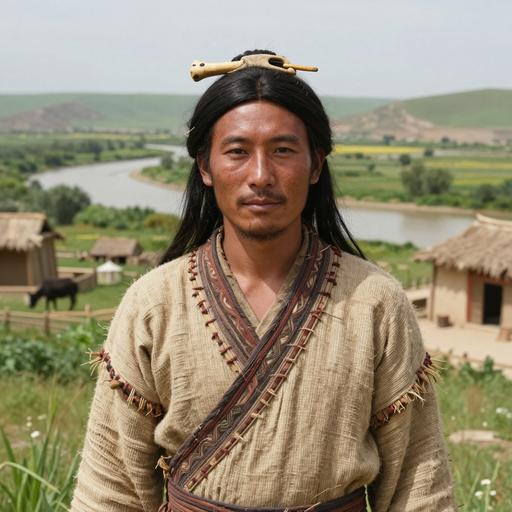
The Story
The journey of mtDNA haplogroup G1C
Origins and Evolution
mtDNA haplogroup G1C branches from the broader haplogroup G1, itself a deep Northeast/East Asian lineage derived from haplogroup G. Based on the phylogenetic position of G1C within G1 and patterns of diversity observed in modern and ancient samples, G1C most likely coalesced in the early Holocene or late Pleistocene (post-Last Glacial Maximum), roughly around ~10 thousand years ago. Its emergence is consistent with a postglacial demographic re-expansion of hunter-gatherer populations in northeastern Asia (Amur region, Sakhalin, Hokkaido, and adjacent Siberian coasts).
The lineage probably formed as small, regionally restricted maternal clades diversified from a more widespread G1 stock during the climatic amelioration after the LGM, when coastal and riverine resources supported population growth and local differentiation.
Subclades
G1C is an intermediate subclade within G1. In published mitochondrial phylogenies G1 splits into several named subclades (e.g., G1a, G1b, G1c/G1C depending on nomenclature conventions); G1C represents one of these geographically localized branches. It is defined by a set of control-region and coding-region mutations used by mtDNA phylogenetic studies to delimit lineages, and it has lower internal diversity than older G1 subclades—consistent with a more recent origin and/or founder events.
Further substructure within G1C is limited and often detectable only with high-resolution complete-mtDNA sequencing; many published population surveys report G1C-level assignment from HVR and a few coding markers, so finer branching is still emerging as more complete sequences from the region are published.
Geographical Distribution
G1C shows a patchy, northern East Asian distribution. It is most frequently observed at low-to-moderate frequencies in:
- Northern Japanese groups (including some Hokkaido and historical Ainu-related samples) and Ryukyuan groups at low frequency.
- Populations of the Russian Far East and adjacent Siberia, including coastal groups of Sakhalin, the Kurils, and Amur-region communities.
- Korean and northeastern Han Chinese samples at low to moderate frequencies in some surveys.
- Mongolic and certain Central Asian groups only rarely, reflecting either long-distance dispersal or low-frequency shared ancestry.
Occurrences in circumpolar communities and the Americas are rare and generally attributed to upstream northeastern Asian sources (Beringian movements or later contacts), but these reports are low frequency and localized.
Historical and Cultural Significance
Because G1C is concentrated in northern East Asia and nearby islands, it is often associated with postglacial coastal and riverine hunter-gatherer populations and the early Holocene cultural trajectories of the region. It may be found in association with archaeological cultures characterized by marine foraging, riverine fishing, and mobile hunter-gatherer-fisher subsistence strategies.
Notably, mtDNA lineages related to G1 (including G1C) have been identified in ancient remains tied to the Jomon and other early Holocene groups of Japan and the Russian Far East, supporting a long-term maternal continuity in parts of the Amur-Sakhalin-Hokkaido zone. The presence of G1C in modern Koreans, northern Chinese, and some Siberian groups reflects both ancient shared ancestry across Northeast Asia and later regional gene flow.
Conclusion
G1C is a geographically focused, postglacial subclade of mtDNA G1 that helps illuminate patterns of maternal continuity and regional differentiation in northeastern Asia after the Last Glacial Maximum. It is best understood through high-resolution complete mitogenome studies and targeted sampling of northern Japanese, Amur/Sakhalin, Korean, and Siberian populations; ongoing sequencing efforts continue to refine its internal structure and historical timing.
Key Points
- Origins and Evolution
- Subclades
- Geographical Distribution
- Historical and Cultural Significance
- Conclusion