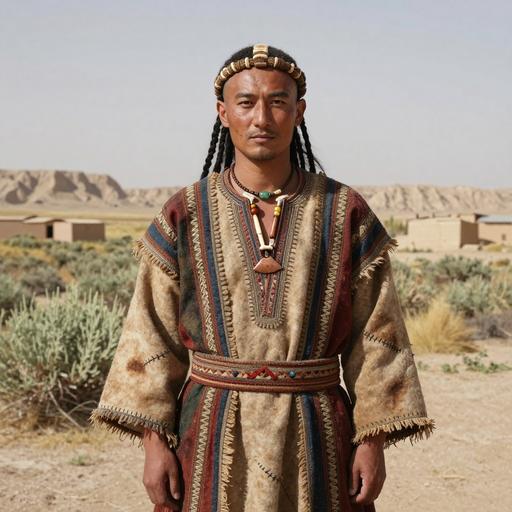
The Story
The journey of mtDNA haplogroup G3A1
Origins and Evolution
mtDNA haplogroup G3A1 is a descendant lineage of G3A (itself a branch of haplogroup G) and likely arose in Northeast/East Asia during the early to mid-Holocene. Its time depth is younger than the parent G3A (estimated ~9 kya) and the emergence of G3A1 at roughly ~7 kya is consistent with regional demographic continuity after the Last Glacial Maximum and with localized maternal expansions in East and Northeast Asia. G3A1 represents one of several G-derived mtDNA lineages that persisted in hunter-gatherer and early Holocene populations across the Russian Far East, Mongolia, and the Japanese archipelago.
Subclades
As a defined terminal subclade of G3A, G3A1 may contain further geographically restricted sublineages detectable only with dense sampling and full mitogenome sequencing. Published and database samples so far indicate limited internal diversity relative to broader G lineages; this pattern is consistent with a regional founder effect and subsequent drift in relatively small, dispersed hunter-gatherer and coastal populations. Ongoing mitogenome studies continue to refine internal branching and identify geographically specific subbranches.
Geographical Distribution
G3A1 is concentrated in Northeast/East Asia and adjacent Siberia. Modern occurrences are most frequent in: northeastern China and Korea, the Russian Far East and Siberian populations (e.g., Yakut, Evenk, Koryak), parts of Mongolia and Buryatia, and Japan—including rare instances among Ainu and some Ryukyuan/Kansai-region samples. Low-frequency, geographically localized occurrences have been reported in some circumpolar groups and in very rare instances in the Americas, reflecting probable late-Pleistocene/Holocene trans-Beringian connections or later small-scale gene flow.
Ancient DNA: G3A1 has been detected in at least two archaeological samples in public databases, supporting continuity of this maternal lineage in the region through the Holocene and giving direct temporal anchoring for its presence in archaeological contexts.
Historical and Cultural Significance
G3A1 is best interpreted as part of the hunter-gatherer-derived maternal substrate of Northeast Asia. Its presence in Japan and among indigenous Siberian groups associates it with coastal and inland forager populations such as the Jomon-related communities in prehistoric Japan and various Neolithic and later hunter-fisher groups of the Russian Far East and sub-arctic Eurasia. Where present among historic-era groups (for example, Ainu and Okhotsk-related populations), G3A1 helps trace maternal continuity and localized demographic events (founder effects, drift, and small-scale migrations) rather than large, continent-wide replacement.
Conclusion
G3A1 is a geographically informative, regionally concentrated mtDNA lineage that documents Holocene maternal continuity in Northeast/East Asia and adjacent Siberia. Its relatively low overall frequency and patchy distribution are consistent with the demographic history of small, often isolated coastal and inland forager groups, with occasional extensions into nearby farming or pastoral populations via contact. Increased mitogenome sampling, especially from under-represented Siberian and ancient contexts, will sharpen estimates of its age, internal structure, and migration history.
Key Points
- Origins and Evolution
- Subclades
- Geographical Distribution
- Historical and Cultural Significance
- Conclusion