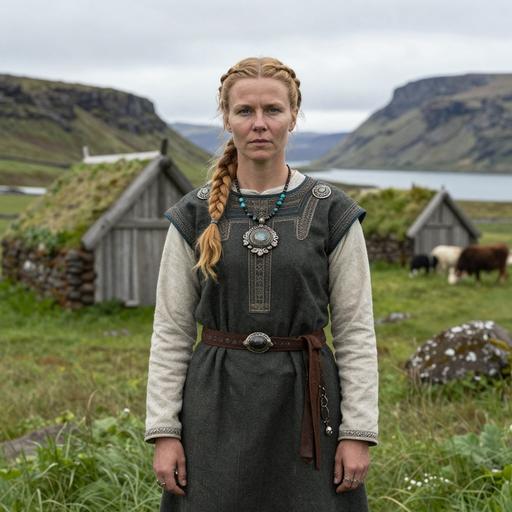
The Story
The journey of mtDNA haplogroup H10A
Origins and Evolution
H10A is a downstream branch of mtDNA haplogroup H10, itself part of the broad European macro-haplogroup H. H10 likely formed in western or adjacent Eurasia in the early Holocene (around ~12 kya), and H10A represents a later divergence within this lineage. Based on the phylogenetic position of H10A and the geographic distribution of its relatives, H10A plausibly arose during the early-to-mid Holocene (several thousand years after the Last Glacial Maximum), a period characterized by post‑glacial re-expansions and the spread of early farming populations.
The mutation profile that defines H10A marks a maternal lineage that diversified locally in parts of Europe and nearby regions. Its age and distribution are consistent with a scenario of regional founder effects, small-scale female-biased demographic events, and incorporation into expanding Neolithic and later Bronze Age communities.
Subclades
Within phylogenies published and in public mtDNA databases, researchers recognize finer substructure beneath H10A (commonly labeled in databases as H10a1, H10a2, etc., depending on the tree version). These subclades are defined by additional private or recurrent mutations and often show more restricted geographic distributions than the parent H10A node. Subclade differentiation likely reflects localized maternal line continuity and later demographic processes (e.g., Bronze Age migrations, medieval movements) that affected regional haplotype frequencies.
Geographical Distribution
H10A is observed at low-to-moderate frequencies across much of Europe with the highest relative densities in western and parts of central Europe. It is also found, at lower levels, in the Near East and northwest Africa—patterns that match post-glacial recolonization routes and later movements of peoples around the Mediterranean.
Ancient DNA (aDNA) studies have identified H10 and related sublineages in Mesolithic, Neolithic and later archaeological contexts in Europe, indicating that members of this maternal lineage were present through multiple major cultural transitions. Modern occurrences are concentrated in:
- Iberia and Atlantic Europe (Spain, Portugal, western France)
- Western and Northern Europe (France, Britain, Ireland, Scandinavia)
- Southern Europe and the Mediterranean (Italy, Greece, the Balkans)
- Central and parts of Eastern Europe (Germany, Poland, Hungary)
Sporadic occurrences in Anatolia, the Levant, and northwest Africa likely reflect both ancient connections and more recent historical contact and gene flow.
Historical and Cultural Significance
Because H10A sits within a broader European H10 lineage that appears in both prehistoric hunter-gatherer and early farming contexts, it is valuable for reconstructing maternal continuity and replacement events. The haplogroup's presence in Neolithic contexts ties it to early farmer dispersals and/or assimilation of local female lineages into incoming farming societies. Its persistence into the Bronze and Iron Ages suggests continuity of some maternal lines through periods of major cultural change.
H10A is useful in archaeogenetics for tracking regional maternal founder events, small-scale migrations (for example, coastal and riverine movements), and the matrilineal components of cultural complexes such as Neolithic farming groups and later pan-European phenomena (e.g., Bell Beaker-associated communities) where it has been observed in limited numbers.
Conclusion
H10A is a comparatively uncommon but informative European maternal lineage derived from H10. Its age (early-to-mid Holocene), patchy but persistent geographic footprint, and presence in both ancient and modern samples make it a marker of localized maternal ancestry and demographic processes across Western, Central and Northern Europe and adjacent regions. Continued sampling and high-resolution mitogenome sequencing will refine its internal structure, age estimates, and finer-scale geographic history.
Key Points
- Origins and Evolution
- Subclades
- Geographical Distribution
- Historical and Cultural Significance
- Conclusion