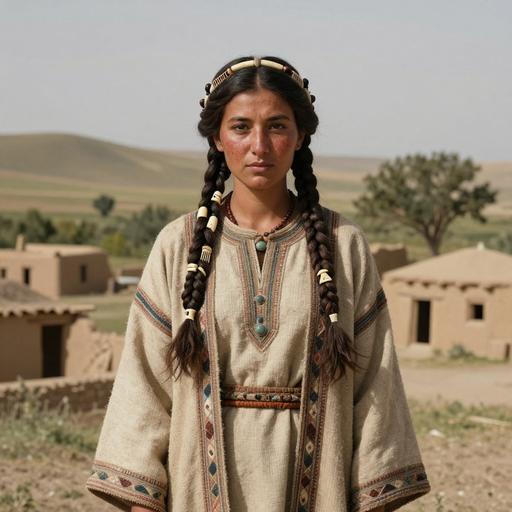
The Story
The journey of mtDNA haplogroup J1B6
Origins and Evolution
mtDNA haplogroup J1B6 is a low‑frequency subclade nested within J1b, itself a branch of haplogroup J that developed in or near the Near East during the Late Glacial / early post‑glacial period. As a downstream lineage, J1B6 carries additional private mutations on top of the defining motif of J1b and likely arose well after the initial diversification of J1b, probably in the Neolithic or early post‑Neolithic timeframe (~6 kya by phylogenetic inference). Its emergence is consistent with continued maternal lineage diversification among Near Eastern and Anatolian farmer populations that subsequently contributed to gene flow into Europe, the Caucasus and North Africa.
Subclades (if applicable)
J1B6 is a terminal or near‑terminal subclade in current phylogenies (reported as a rare, relatively recently derived branch). Because J1B6 has few documented downstream branches in public databases and only a small number of confirmed samples, its internal substructure is limited and most observations map to a single clade defined by private mutations downstream of J1b. Continued mitogenome sequencing of diverse populations may reveal further internal subclades.
Geographical Distribution
Although parent clade J1b shows a broad Near Eastern and Mediterranean distribution at low to moderate frequencies, J1B6 itself is rare and has been observed at low frequencies in multiple neighboring regions consistent with Neolithic and later dispersals from the Near East. Reported occurrences (including two aDNA finds in available databases) indicate presence in:
- The Near East and Anatolia (where it likely originated)
- Southern and parts of Western Europe (trace presence among populations with Near Eastern admixture)
- North Africa (along Mediterranean coastal zones)
- The Caucasus and adjacent areas
- Scattered occurrences in parts of Central Asia
The low frequency and patchy distribution of J1B6 fit a model of a Near Eastern origin followed by limited dispersal with Neolithic farming expansions, later trade and population movements, and localized survival in specific maternal lineages.
Historical and Cultural Significance
Because J1B6 derives from lineages prominent among Near Eastern early farmers, it is informative for tracking the maternal component of Neolithic farmer migrations into Europe and the Mediterranean. Its presence in aDNA contexts (albeit limited) supports archaeological associations with Neolithic and post‑Neolithic communities. J1B6 is not known as a signature lineage of large steppe expansions (e.g., Yamnaya) or of Bell Beaker communities; rather it aligns with farmer‑associated mitochondrial diversity and later historical population movements around the Mediterranean and Near East, including potential detection in some Jewish communities where multiple Near Eastern maternal lineages persist.
Conclusion
J1B6 is a rare, recently derived subclade of J1b that exemplifies the ongoing diversification of Near Eastern maternal lineages since the Neolithic. Its low frequency and scattered presence across the Near East, Mediterranean Europe, North Africa and the Caucasus reflect a history of Neolithic dispersal, localized demographic drift, and later regional contacts. More full‑mitogenome sampling across understudied populations and ancient remains will improve resolution of its age, migrations and internal structure.
Key Points
- Origins and Evolution
- Subclades (if applicable)
- Geographical Distribution
- Historical and Cultural Significance
- Conclusion