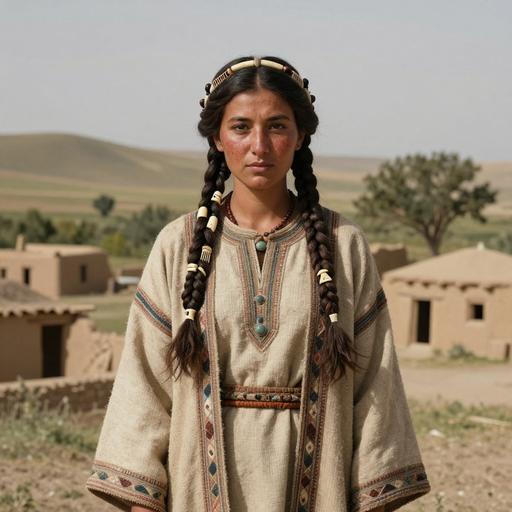
The Story
The journey of mtDNA haplogroup J1D7
Origins and Evolution
mtDNA haplogroup J1D7 is a downstream branch of J1D, itself a subclade of mtDNA haplogroup J1. The parent clade J1D has been tied to early Holocene (post-glacial and Neolithic) demographic expansions from the Near East into the Mediterranean and adjacent regions. By contrast, J1D7 appears to have a shallower time depth within that parental framework and most parsimoniously arose in the Near East or eastern Mediterranean region during the later Holocene, roughly in the Bronze Age (around 3–5 kya). Its emergence likely reflects local diversification within established maternal J1D lineages and subsequent regionally mediated dispersal events rather than the primary Neolithic spread associated with earlier J subclades.
Subclades
J1D7 is itself a terminal or near-terminal branch in many published phylogenies and public mtDNA databases, and as such it has limited documented downstream substructure compared with older J subclades. Where deeper sampling exists, J1D7 may show minor internal diversity reflecting localized founder events (for example, coastal or island settlements). Because J1D7 is relatively rare in available modern and ancient datasets, detailed internal branching remains incompletely resolved and will benefit from broader full mitogenome sequencing in Mediterranean and Near Eastern populations.
Geographical Distribution
The geographic footprint of J1D7 follows a broadly Mediterranean and Near Eastern pattern, consistent with the distribution of many J1-derived lineages. Modern detections are predominantly:
- Along Mediterranean coasts of Southern and Western Europe (particularly Italy, the central/southern Mediterranean fringe and parts of the Iberian Peninsula),
- In the Levant and Anatolia, reflecting a likely Near Eastern origin and persistence,
- In North African coastal populations (Maghreb and nearby coastal zones), and
- In small numbers within diasporic Jewish maternal lineages and some Caucasus or eastern Mediterranean fringe populations.
The haplogroup is typically found at low absolute frequencies (often well below common mtDNA lineages such as H) but displays elevated local frequencies where founder effects or historical demography concentrated maternal founders.
Historical and Cultural Significance
Because J1D7 is younger than many primary J clades, its historical signal is more consistent with Bronze Age and later movements rather than the earliest Neolithic farming expansions. Plausible mechanisms for its spread include long-distance trade and seafaring across the Mediterranean, population movements during the Bronze Age (including coastal networks of the Levant, Anatolia and the Aegean), and later historical processes such as Phoenician colonization, Greek and Roman-era mobility, and medieval-to-early modern diasporas (including some Jewish maternal lineages).
It is important to emphasize that the presence of J1D7 in a region does not uniquely identify a single historical migration; the lineage's distribution is best interpreted alongside archaeological, linguistic, and autosomal evidence. Given the haplogroup's rarity, individual occurrences can also reflect recent genealogical events or localized founder effects.
Conclusion
J1D7 represents a relatively young, regionally focused offshoot of the J1D maternal lineage, rooted in the Near East and subsequently carried into Mediterranean and adjacent regions during the Bronze Age and later periods. Its low frequency and limited deep substructure make it a useful marker for fine-scale maternal phylogeography when combined with other genetic and archaeological data, but broader mitogenome sampling is needed to fully resolve its internal diversity and precise migratory episodes.
Key Points
- Origins and Evolution
- Subclades
- Geographical Distribution
- Historical and Cultural Significance
- Conclusion