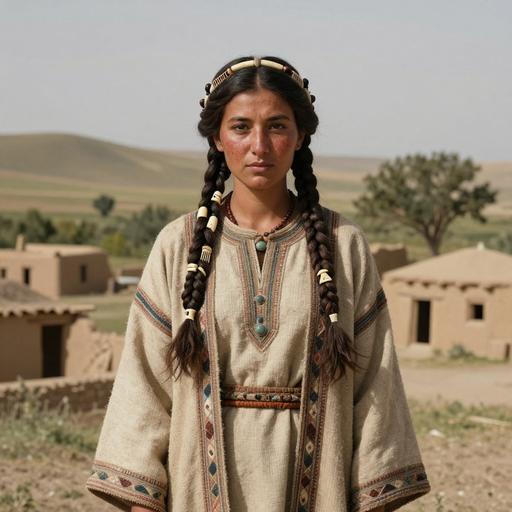
The Story
The journey of mtDNA haplogroup J1D9
Origins and Evolution
mtDNA haplogroup J1d9 is a downstream subclade of the maternal lineage J1d, itself nested within haplogroup J1. J1d has been tied by population genetics studies to early Holocene expansions that originated in the Near East and spread into the Mediterranean littoral, Europe, and North Africa with Neolithic and post‑glacial movements. As a subclade, J1d9 represents a later branching event within that broader J1d radiation; based on its phylogenetic position and mutation accumulation relative to J1d, a reasonable estimate for the coalescence of J1d9 is in the mid‑Holocene (several thousand years after the origin of J1d). The lineage is therefore interpreted as part of the continuing diversification of Near Eastern maternal lineages during/after the Neolithic.
Subclades
At present J1d9 is recognized as a narrowly defined terminal branch within J1d (coverage and naming conventions can vary between databases). Because J1d9 is rare and only sparsely sampled, few or no well‑established downstream subclades have robustly documented frequencies; future full mitogenome sampling in the eastern Mediterranean and North Africa may reveal additional internal structure. In phylogenetic terms, J1d9 shares the diagnostic mutations of J1 and J1d and is defined by one or a few additional private mutations that distinguish it from other J1d lineages.
Geographical Distribution
Modern distribution: J1d9 is observed at low frequencies across a Mediterranean‑Near Eastern arc. It is most likely to appear in coastal and near‑coastal populations of the Levant, Anatolia, southern Europe (particularly Mediterranean coastal groups), and the Maghreb, with occasional occurrences reported in the Caucasus and parts of Central Asia. The pattern is consistent with diversification within a Near Eastern source population followed by maritime and overland dispersals.
Ancient DNA: The lineage has been detected in at least one archaeological sample in curated databases, indicating continuity or reintroduction in archaeological contexts; however, the ancient record for J1d9 remains very sparse, limiting precise inference about its role in specific prehistoric migrations.
Historical and Cultural Significance
Because of its origin and distribution, J1d9 is best interpreted as part of the maternal legacy of Neolithic and later Mediterranean demographic processes. J‑lineages, including J1 and J1d, are frequently associated in population studies with early farmer expansions from Anatolia/Levant into the Mediterranean and Europe; J1d9, as a later branch, may reflect localized diversifications of those farmer communities or subsequent coastal movements (trade, colonization, and small‑scale migrations) in the Bronze Age and later historical periods. Its presence at low levels among Jewish diaspora communities in some studies suggests that J1d derivatives have been incorporated into multiple maternal gene pools over millennia.
It is important to emphasize that J1d9 is not a marker of a single culture or people but rather a maternal lineage that can track broad population connections (Near East ↔ Mediterranean ↔ North Africa) and the demographic processes—migration, admixture, and drift—that shaped them.
Conclusion
J1d9 is a low‑frequency, regionally focused mtDNA subclade of J1d that most likely arose in the Near East during the mid‑Holocene and spread at low levels into Mediterranean Europe, North Africa, and neighboring regions. Current evidence is limited by sparse sampling and the rarity of the clade; more full mitogenome sequencing from the eastern Mediterranean, Anatolia, and North Africa would improve resolution of its internal structure, chronology, and historical trajectories. Until then, J1d9 should be treated as part of the broader Neolithic‑derived maternal heritage of the Mediterranean and adjacent areas, with episodic appearances in ancient and modern populations reflecting complex demographic histories.
Key Points
- Origins and Evolution
- Subclades
- Geographical Distribution
- Historical and Cultural Significance
- Conclusion