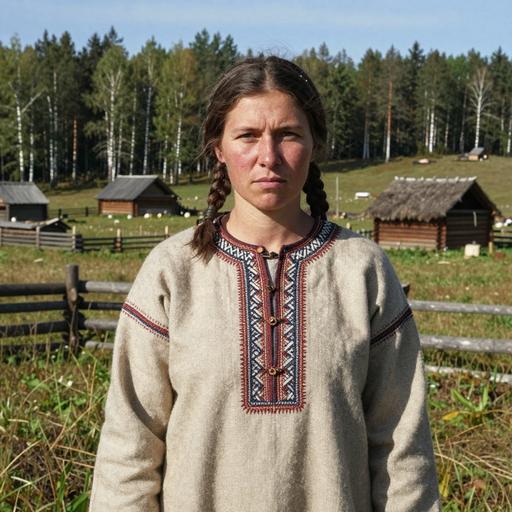
The Story
The journey of mtDNA haplogroup T2B4
Origins and Evolution
mtDNA haplogroup T2B4 descends from T2B, itself a branch of haplogroup T2. The parent clade T2B is generally inferred to have arisen on the Near Eastern / Mediterranean margin after the Last Glacial Maximum (user-provided context ~14 kya), and T2B4 represents a later, nested lineage that likely formed during the early postglacial to Neolithic timeframe (estimated here at ~8 kya). This timing is consistent with a pattern in which diverse T2 sublineages expand with movements of Near Eastern-derived populations into Europe during the postglacial recolonization and the Neolithic transition.
Molecular clock uncertainty and limited full-mitogenome sampling for some rare subclades means the precise date for T2B4 remains provisional; targeted complete mtDNA sequencing and additional ancient DNA (aDNA) sampling would refine the estimate.
Subclades (if applicable)
As a relatively specific sublineage within T2B, T2B4 currently shows limited documented internal structure compared with major basal T2 branches. Modern and ancient mitogenomes assigned to T2B4 indicate at least a few regionally restricted sublineages, but comprehensive naming of internal subclades depends on expanded full-mitogenome datasets. In practice, T2B4 can be treated as a useful marker of Near Eastern-derived maternal ancestry in many European and Mediterranean contexts, and further sequencing frequently reveals new downstream variants.
Geographical Distribution
T2B4 is most frequently recorded in populations along the Mediterranean and southern European corridor, with lower-frequency occurrences farther north and east. Observations come from modern population surveys and from aDNA: your dataset notes 18 archaeological samples with T2B4, supporting a role in historical demography. Key geographic patterns: southern and central Europe (Italy, Iberia, Balkans) show recurrent occurrences, the Near East (Anatolia, Levant) hosts lineages consistent with origin and continued presence, and low-frequency occurrences appear in North Africa, the Caucasus and Central Asia. Small proportions of Jewish communities (including some Ashkenazi lineages) carry T2B4, reflecting historical Near Eastern and Mediterranean matrilineal connections.
Historical and Cultural Significance
Because T2B4 sits within the broader T2B/T2 phylogeny that is associated with postglacial expansions and the Neolithic spread of farmers from Anatolia/Levant into Europe, its presence in ancient and modern samples is often interpreted as a trace of these demographic processes. In early Neolithic archaeological contexts (for example, Anatolian and Early European Neolithic farmers), T2 lineages appear commonly, and derived subclades such as T2B4 can indicate maternal ancestry connected to those movements.
Later demographic events — including Bronze Age migrations and historical Mediterranean contacts — redistributed maternal lineages and produced the patchy, lower-frequency distribution seen today. The presence of T2B4 in some Jewish and North African samples reflects both ancient Near Eastern origins and subsequent diasporic or coastal connections across the Mediterranean.
Conclusion
T2B4 is a geographically informative, modest-frequency mitochondrial lineage tied to the Near Eastern / Mediterranean maternal gene pool and later dispersals into Europe. It is particularly useful in combination with other genetic and archaeological evidence for reconstructing postglacial and Neolithic female-mediated migrations, though precise time-depth and internal structure require expanded full mitogenome sequencing and further aDNA sampling to resolve.
Key Points
- Origins and Evolution
- Subclades (if applicable)
- Geographical Distribution
- Historical and Cultural Significance
- Conclusion