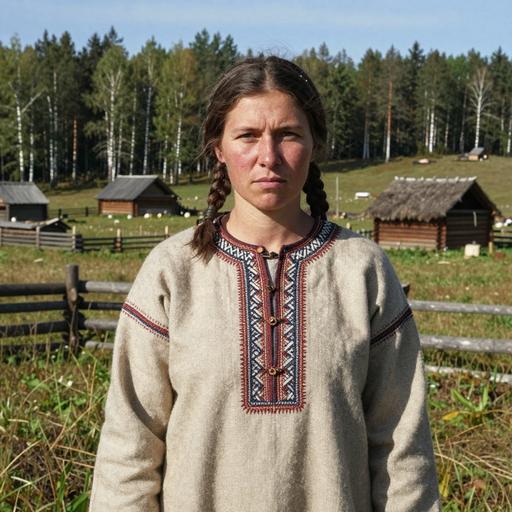
The Story
The journey of mtDNA haplogroup T2B44
Origins and Evolution
mtDNA haplogroup T2B44 is a downstream lineage of T2B4 (itself a branch of T2B within haplogroup T2). The parent clade T2B4 is estimated to have arisen on the Near Eastern / Mediterranean fringe in the early postglacial to Neolithic interval (~8 kya). Given that T2B44 sits below T2B4 in the phylogeny, a reasonable inference—supported by the limited available modern and ancient DNA evidence—is that T2B44 originated later than the parent clade, most likely during the mid- to late-Neolithic or in subsequent post-Neolithic periods (we estimate ~4 kya for T2B44's coalescence). As with many T2 subclades, T2B44 derives from maternal lineages associated with the spread of Near Eastern farmer-derived mitochondrial diversity into Europe and adjacent regions.
Subclades (if applicable)
At present T2B44 is a relatively narrowly defined subclade and publicly available surveys report it at low frequency; there are few well-documented downstream branches described in the literature or large public phylogenies. Future high-coverage sequencing and expanded ancient DNA sampling may reveal further diversification within T2B44 and clarify whether regional sublineages exist (for example Mediterranean vs. continental European branches). For now, T2B44 should be treated as a low-frequency, geographically diffuse subclade of T2B4.
Geographical Distribution
Modern distribution: T2B44 is observed at low-to-very-low frequencies across the Mediterranean and adjoining regions, mirroring the broader distribution of T2B4 but typically rarer. Confirmed occurrences and screening hits come from southern and central Europe (Italy, Iberia, the Balkans), from parts of Eastern Europe, from Anatolia and the Levant, and sporadically from North Africa, the Caucasus and Central Asia. It has also been detected in some Jewish maternal lineages at low frequency, consistent with the complex maternal ancestry of Jewish diasporas.
Ancient DNA: T2B44 has a very limited presence in published ancient DNA datasets (noted in one archaeological sample in the dataset referenced by the user), indicating at least occasional representation in prehistoric or historic populations; however, the aDNA record for this specific subclade remains sparse.
Historical and Cultural Significance
Because of its phylogenetic position under T2B4, T2B44 is best interpreted as part of the maternal legacy associated with the Neolithic expansion of farming populations from Anatolia and the Near East into Europe, and with later Mediterranean population movements. Its low frequency and patchy distribution suggest it was never a dominant maternal lineage but rather one of many lineages that spread with early farmers and subsequently drifted, admixed, or persisted in small population pockets.
In later periods, such as the Bronze Age and historic times, T2B44 may have been carried by maritime and overland movements across the Mediterranean and into adjacent regions (for example through trade, settlement, or small-scale migrations). Its presence in some Jewish populations likely reflects medieval and later admixture/adoption of local maternal lines as well as founder effects in limited lineages.
Conclusion
T2B44 is a minor, regionally scattered subclade of T2B4 that provides a small but informative piece of the maternal genetic mosaic of the Mediterranean, Near East and adjoining regions. While not abundant, its distribution is consistent with Neolithic-era dispersals from the Near East followed by long-term local persistence and sporadic dispersal. Expanded sequencing of modern populations and more ancient DNA sampling will be required to refine its age, internal structure, and historical trajectories.
Key Points
- Origins and Evolution
- Subclades (if applicable)
- Geographical Distribution
- Historical and Cultural Significance
- Conclusion