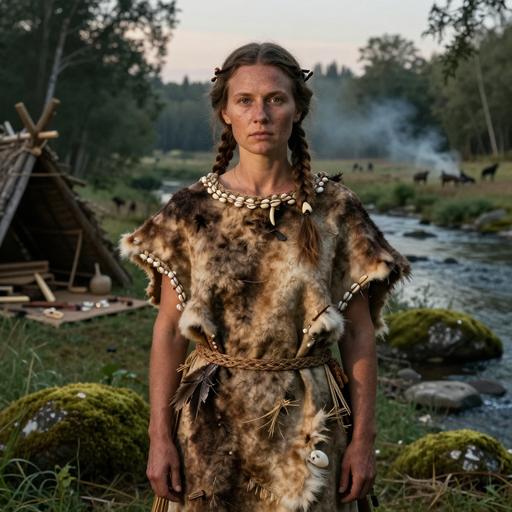
The Story
The journey of mtDNA haplogroup U4B
Origins and Evolution
Haplogroup U4B is a downstream branch of mtDNA haplogroup U4, itself part of the broader U family that has deep roots in Upper Paleolithic and postglacial Eurasia. Based on phylogenetic position within U4 and the distribution of related lineages in ancient DNA, U4B most plausibly diversified in Northern or Eastern Europe during the Late Glacial or the Early Holocene (roughly 15 kya), a period of demographic recovery and regional differentiation after the Last Glacial Maximum. The timing and geography are consistent with U4's role among European hunter-gatherers and with subsequent dispersals into adjacent regions of northern Eurasia.
Subclades
U4B comprises one or more downstream branches that have been identified in modern and ancient datasets (often labeled as U4b1, U4b2, etc., in different nomenclatures). Subclade resolution in published datasets varies with sampling and sequencing depth; some recognized sublineages of U4 have distinct geographic tendencies (for example, some U4b-associated subbranches show stronger representation in parts of Siberia and Central Asia, while others are concentrated in Scandinavia and the Baltic).
Geographical Distribution
U4B shows a patchy but coherent distribution across northern Eurasia. It is most frequently reported in Northern and Eastern Europe (including Scandinavia, the Baltic region and northwestern Russia), and it is also found at lower frequencies in Siberian and some Central Asian populations. Occasional occurrences in the Caucasus and in South Asia have been reported at low frequency, likely reflecting either ancient steppe-mediated contacts or later long-distance movements. Ancient DNA studies recover U4 and U4-derived lineages in Mesolithic European hunter-gatherers and in some Bronze Age steppe-associated assemblages, consistent with continuity and intermittent gene flow across these regions.
Historical and Cultural Significance
U4B is informative for studies of postglacial recolonization of northern Europe and for the genetic composition of Mesolithic hunter-gatherer groups. In later periods, U4-derived lineages (including U4B) appear in contexts associated with steppe expansions and with eastern–northern European cultural horizons; this makes U4B a useful marker for tracing maternal ancestry in ancient populations tied to those events. While not a defining marker of any single archaeological culture, its presence alongside other hunter-gatherer mtDNA lineages (e.g., U5) and later admixture-derived maternal components helps reconstruct the shifting maternal landscape from the Mesolithic through the Bronze Age.
Conclusion
mtDNA U4B is a regional subclade of U4 that reflects Late Glacial/Early Holocene diversification in northern Eurasia and a lasting association with hunter-gatherer-descended populations of Northern and Eastern Europe. Its detection in both ancient and modern samples across northern Eurasia makes it a valuable lineage for studies of postglacial demography, interactions between forager and incoming farming or pastoralist groups, and the maternal legacy of Bronze Age movements across the steppe.
Key Points
- Origins and Evolution
- Subclades
- Geographical Distribution
- Historical and Cultural Significance
- Conclusion