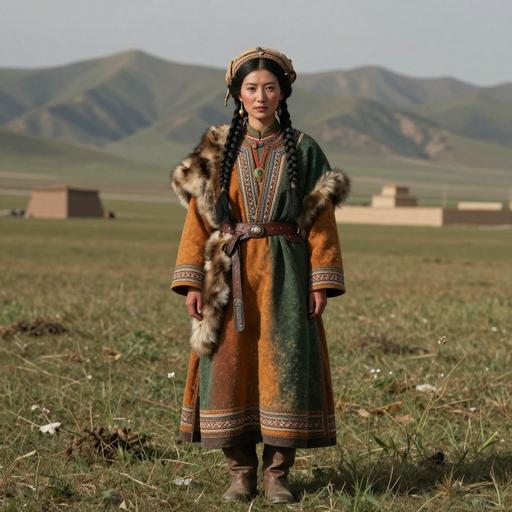
The Story
The journey of mtDNA haplogroup U6A1B2
Origins and Evolution
mtDNA haplogroup U6A1B2 is a downstream subclade of U6A1B within the broader North African U6 lineage. U6 as a whole is widely interpreted as a Holocene (and late Pleistocene for deeper branches) North African-centric maternal clade with links to post-glacial expansions and early Holocene population dynamics in the Maghreb. U6A1B2 likely arose in the Maghreb during the mid-Holocene (~6 kya) as a localized mutation event on the branch defined by U6A1B, and its phylogenetic position indicates it is a relatively young, geographically restricted lineage compared with older U6 subclades.
Mutational patterns on the U6 phylogeny and coalescence estimates for adjacent subclades support a Maghrebi origin and a history shaped by both local continuity and limited maritime or coastal dispersals across the western Mediterranean. The presence of U6A1B2 in isolated insular contexts (the Canary Islands) and in southwestern Iberia is consistent with low-level Holocene and historic gene flow across the Strait of Gibraltar and along Atlantic coasts.
Subclades (if applicable)
U6A1B2 itself is a specific terminal subclade of U6A1B. As a derived lineage it may have very few or no widely recognized downstream subbranches in published datasets (many U6 terminal clades are represented by single or few haplotypes). Its closest relatives on the tree include other U6A1B-derived lineages (for example sibling subclades such as U6A1B1 or other U6A1 sub-branches), which together document diversification within the Maghreb during the mid- to late Holocene. The limited number of derived samples means the substructure inside U6A1B2 is currently minor and often represented by private mutations in modern or ancient individuals.
Geographical Distribution
The geographic distribution of U6A1B2 is concentrated in the western Maghreb and shows measurable but low-frequency presence across adjacent regions of the western Mediterranean. Observed patterns include:
- High relative concentration in Berber-speaking populations of Morocco, Algeria, and Tunisia, consistent with longstanding maternal continuity in the region.
- Presence in the Canary Islands (Guanche remains and modern islanders) reflecting a prehistorical/early-historical expansion from the northwest African coast to the archipelago.
- Sporadic detections in southwestern Iberia (southern Spain and Portugal), compatible with maritime contacts, trans-Mediterranean exchange, or historic movements across the Gibraltar corridor.
- Low-frequency observations in parts of East Africa (Ethiopia, Somalia) and the Near East, which may reflect long-term low-level gene flow, historical trade networks, or more recent migrations.
The haplogroup has been identified in at least one ancient DNA sample in archaeological contexts, supporting its presence in pre-modern populations rather than being solely a recent arrival.
Historical and Cultural Significance
U6A1B2 is informative for reconstructing Maghrebi maternal ancestry and the micro-demographic processes that shaped northwest Africa after the Neolithic. Its occurrence among indigenous Guanche lineages in the Canary Islands gives it particular value for studies of island colonization and the prehistoric peopling of Atlantic Macaronesia. In Iberia, U6-derived lineages in general have been interpreted as signals of either prehistoric coastal contacts or later historic movements (Phoenician, Roman, Islamic medieval contacts); U6A1B2's distribution favors a scenario in which Holocene coastal/maritime mobility and localized founder effects contributed to its spread.
The lineage complements archaeological and linguistic evidence for long-term continuity of Berber groups in the Maghreb and documents one component of the female gene pool that persisted through multiple cultural transitions (Neolithic, later Bronze/Iron Age exchanges, and historical era movements).
Conclusion
U6A1B2 is a geographically focused, mid-Holocene mtDNA subclade rooted in the Maghreb that serves as a marker of Maghrebi maternal heritage and of limited west Mediterranean dispersal routes (notably to the Canary Islands and southwestern Iberia). Its rarity and localized nature make it useful for high-resolution regional studies of maternal ancestry, island colonization, and historical connectivity between North Africa and surrounding regions. As additional mitogenomes are sequenced from both modern and ancient contexts, U6A1B2's internal diversity and precise dispersal chronology may become clearer, refining its role in North African population history.
Key Points
- Origins and Evolution
- Subclades (if applicable)
- Geographical Distribution
- Historical and Cultural Significance
- Conclusion