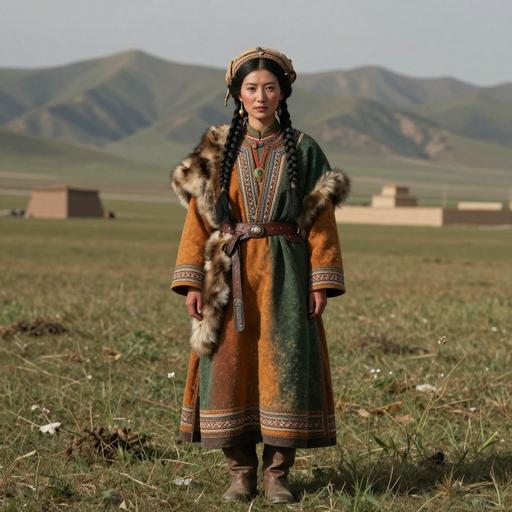
The Story
The journey of mtDNA haplogroup U6A2
Origins and Evolution
mtDNA haplogroup U6A2 sits within the broader U6a branch, itself a major North African subclade of haplogroup U6. U6a likely expanded in North Africa during the Late Pleistocene (the parent U6A is commonly dated to ~22 kya), and U6A2 represents a later diversification likely occurring in the Maghreb during the Late Glacial or early Holocene (roughly the last 10–14 kya). The emergence of U6A2 is best interpreted as part of the regional maternal diversification that followed climatic amelioration after the Last Glacial Maximum, producing lineages that persisted in North African refugia and later contributed to coastal and island dispersals.
Subclades (if applicable)
U6A2 itself is a named sub-branch of U6a. Published phylogenies and population surveys identify several U6a sublineages (e.g., U6a1, U6a2, U6a3, etc.) with overlapping yet distinct geographic footprints; U6A2 appears as one of these regionally concentrated lineages. Where dense full-mtDNA sequencing is available, U6A2 can be further subdivided into local sublineages that reflect more recent demographic events (Holocene expansions, island founder effects), but sampling remains patchy compared with major Eurasian mtDNA clades.
Geographical Distribution
U6A2 is most prevalent in Northwest Africa (the Maghreb), particularly among Berber-speaking groups and other indigenous North African populations. From this core area, secondary dispersals dispersal pathways include the western Mediterranean:
- The Iberian Peninsula (especially southwestern Spain and Portugal) shows low-to-moderate frequencies, reflecting prehistoric and historic cross-strait contacts.
- The Canary Islands harbor U6 lineages (including U6a-derived types) in both ancient Guanche remains and modern islanders, consistent with maritime colonization from North Africa.
- At low frequencies, U6A2 or closely related U6a sublineages are detected in parts of East Africa (e.g., the Horn) and the Near East, likely reflecting episodic gene flow across the Sahara and along coastal corridors.
Overall, the distribution is North African-centered with Mediterranean and limited trans-Saharan echoes.
Historical and Cultural Significance
U6 lineages (including U6A2) are often discussed in the context of North African continuity: they provide genetic evidence for long-term maternal continuity in the Maghreb from the Late Pleistocene into the Holocene and into historic times. U6A2's presence in the Canary Islands and Iberia documents prehistoric maritime and coastal interactions across the western Mediterranean and Atlantic interface. In archaeological contexts, U6a-derived lineages have been associated with North African Epipaleolithic/Neolithic and later indigenous cultures; for U6A2 specifically, denser ancient DNA sampling would clarify whether it participated prominently in particular cultural expansions (e.g., local Neolithic transitions) or mostly reflects localized continuity and later coastal dispersals.
Conclusion
U6A2 is a regional maternal lineage nested within U6a that highlights the Maghreb as a center of Holocene maternal diversification. Its pattern—highest frequencies in North Africa with secondary, lower-frequency presence in Iberia, the Canary Islands and portions of East Africa and the Near East—matches expectations for a lineage that diversified locally after the Last Glacial Maximum and contributed to both inland continuity and maritime dispersals in the western Mediterranean. Continued full-mitogenome sequencing and ancient DNA sampling from North Africa and adjacent regions will refine the internal branching, age estimates, and the specific migratory events connected to U6A2.
Key Points
- Origins and Evolution
- Subclades (if applicable)
- Geographical Distribution
- Historical and Cultural Significance
- Conclusion