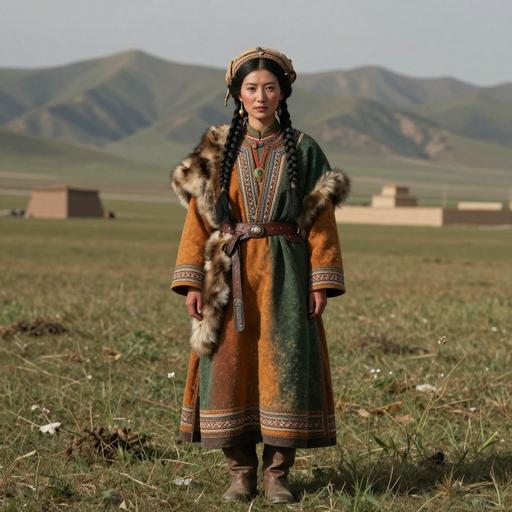
The Story
The journey of mtDNA haplogroup U6A6
Origins and Evolution
mtDNA haplogroup U6A6 is a downstream branch of U6A, itself a major subclade of U6 that has long been associated with North African maternal lineages. U6A is thought to have diverged in North Africa during the Late Pleistocene (~22 kya) and subsequently diversified. U6A6 likely arose later, during the Early Holocene (roughly 9 kya, with uncertainty), as local U6A diversity increased following the Last Glacial Maximum and during post-glacial demographic expansions in North Africa.
The precise coalescence date for U6A6 is uncertain because of limited published ancient DNA samples assigned specifically to this subclade. Estimates here rely on the position of U6A6 within the U6A phylogeny and typical mutation-rate calibrations used in mitochondrial studies. As with many downstream mtDNA clades, U6A6's emergence likely reflects local population growth and substructure rather than a single abrupt migration event.
Subclades (if applicable)
U6A6 is an intermediate terminal clade in published phylogenies; depending on sequencing depth and sample coverage, small downstream branches of U6A6 may be recognized in large dataset analyses. Published literature more frequently treats U6A and its major subdivisions; therefore, U6A6 may be represented by a few population-specific lineages rather than a broad, deeply branched subclade. Continued mitogenome sequencing of North African and adjacent Mediterranean populations will clarify whether U6A6 contains stable, geographically structured sub-branches.
Geographical Distribution
U6A6 shows its highest frequencies and diversity in North Africa, particularly among Berber-speaking communities of Morocco, Algeria and Tunisia. From North Africa it has been carried at low to moderate frequencies into adjacent regions: the Iberian Peninsula (southwestern Spain and Portugal) via prehistoric and historic trans-Mediterranean contacts, the Canary Islands through pre-Hispanic colonization from North Africa (where other U6 lineages are common), and into parts of East Africa and the Near East at low frequencies likely driven by ancient and historic gene flow.
The geographic pattern of U6A6 — concentrated in North Africa with scattered presence around the western Mediterranean and into East Africa — mirrors the broader distribution of U6 sublineages and supports a model of long-term local continuity in North Africa combined with episodic dispersals across the Mediterranean and along African corridors.
Historical and Cultural Significance
Genetically, U6 lineages (including U6A and its subclades) are often used as markers of indigenous North African maternal ancestry. U6A6's presence in Berber populations links it to the deep pre-Neolithic and Holocene history of the Maghreb. Archaeologically, U6A6 is plausibly associated with North African Mesolithic and early Holocene cultural horizons (for example, cultures collectively characterized in some literature as the Capsian or regional hunter-gatherer/early food-procurement groups), though direct ancient-DNA attribution to specific archaeological cultures is still limited.
The subclade's low-frequency occurrence in Iberia and the Canary Islands is consistent with prehistoric trans-Mediterranean movements (including maritime contacts) and later historic interactions (Phoenician, Roman, Islamic periods), as well as with the well-documented North African contribution to the maternal gene pool of the Canary Islands' indigenous Guanche population.
Conclusion
U6A6 represents a regionally informative, North African-centered maternal lineage deriving from the broader U6A clade. Its pattern — concentrated in the Maghreb with peripheral low-frequency occurrences in neighboring regions — underscores North Africa's role as both a long-term refugium and a source of limited outward maternal gene flow into the western Mediterranean and parts of Africa and the Near East. Continued targeted mitogenome sequencing and ancient DNA recovery from North Africa and adjacent regions will refine the age, internal structure, and dispersal history of U6A6.
Key Points
- Origins and Evolution
- Subclades (if applicable)
- Geographical Distribution
- Historical and Cultural Significance
- Conclusion