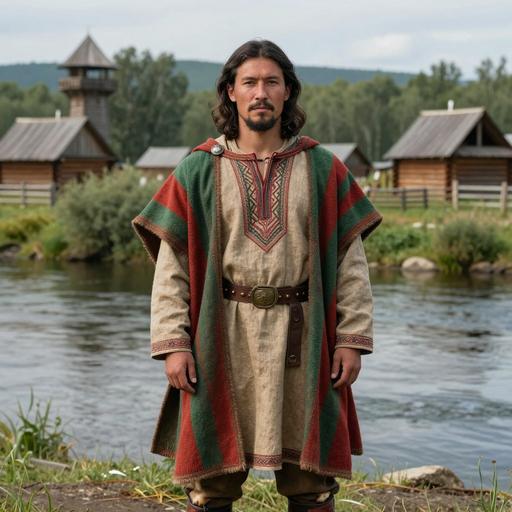
The Story
The journey of mtDNA haplogroup D4O2A2A
Origins and Evolution
Haplogroup D4O2A2A sits as a downstream branch of D4O2A2 within the broader mtDNA haplogroup D4 complex, a lineage with deep roots in northern and eastern Asia. Based on the parent clade D4O2A2's estimated mid-Holocene emergence (~6 kya) and the phylogenetic depth of observed D4O2A2A sequences, D4O2A2A most plausibly originated in Northeast Asia around the mid- to late-Holocene (roughly 4 kya). Its derived mutations appear in a handful of modern and ancient full mitogenomes, indicating a relatively recent split from the parental branch and subsequent survival in small, localized maternal lineages rather than broad demographic expansions.
Detection and confident placement of D4O2A2A relies on high-resolution mitogenome sequencing; low-coverage or control-region-only datasets often miss the diagnostic mutations that define this terminal subclade. The pattern—rare, scattered modern occurrences plus a few ancient hits—fits a model of regional persistence in small forager or mixed coastal communities with limited dispersal.
Subclades (if applicable)
At present D4O2A2A appears to be a terminal or low-diversity subclade with very few documented downstream branches. Unlike major D4 subclades that diversified widely, D4O2A2A shows limited internal structure in available datasets; future mitogenome sampling in northeastern Asia and ancient DNA work may resolve minor sublineages or reveal further splits. For now it should be treated as a rare, localized lineage derived from D4O2A2.
Geographical Distribution
D4O2A2A is geographically concentrated in the Northeast Asian and adjacent Siberian region but occurs at very low frequencies across a range of populations. Modern occurrences have been reported at very low frequency among Han Chinese, Japanese and Korean samples in some sequencing datasets, and among indigenous Siberian groups (e.g., Yakut, Evenk and neighboring Tungusic-speaking populations). Sporadic, low-frequency reports appear in Mongolic-speaking groups of northeastern Mongolia and in some Turkic and Central Asian datasets, consistent with limited gene flow or recent mobility. Importantly, D4O2A2A has also been observed in a small number of ancient Holocene hunter-gatherer contexts in the Russian Far East and northern Japan, indicating continuity of a maternal lineage in coastal and inland northeastern Asia since the Holocene.
Historical and Cultural Significance
Because D4O2A2A is rare and geographically restricted, its main significance is as a marker of regional maternal continuity rather than as a driver of large-scale prehistoric migrations. Its presence in ancient samples connected with coastal or Amur-region hunter-gatherer contexts, and its low-level persistence in modern Northeast Asian and Siberian populations, suggests survival of small maternal lineages through transitions such as the spread of Neolithic practices, later Bronze Age movements, and recent historic population changes.
Associations with archaeological contexts that carry Jomon- or Okhotsk-related ancestry in northern Japan and the Russian Far East further point to a role in tracing coastal population histories, local admixture, and maternal lineage survival among groups that retained substantial forager or mixed subsistence strategies into the Holocene.
Conclusion
D4O2A2A is a diagnostically narrow, low-frequency mtDNA subclade of D4O2A2 that likely arose in Northeast Asia in the mid- to late-Holocene. It is most informative for regional studies of maternal continuity and fine-scale population structure in northeastern Asia and adjacent Siberia. Continued high-resolution mitogenome sequencing—especially of under-sampled indigenous communities and ancient remains—will clarify its internal diversity and precise temporal and geographic trajectory.
Key Points
- Origins and Evolution
- Subclades (if applicable)
- Geographical Distribution
- Historical and Cultural Significance
- Conclusion