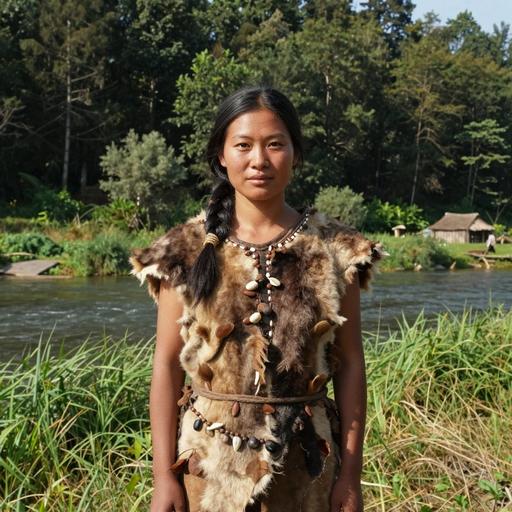
The Story
The journey of mtDNA haplogroup D4H
Origins and Evolution
Haplogroup D4h is a recognized subbranch of the larger mtDNA haplogroup D4, which diversified in East and Northeast Asia during the Late Pleistocene. Based on phylogenetic position within D4 and comparative molecular-clock estimates for neighboring subclades, D4h most likely split from other D4 lineages shortly after the Last Glacial Maximum (roughly ~16 kya). The lineage reflects population structure and post-glacial demographic processes in Northeast Asia, with subsequent range extensions into Siberia, coastal East Asia, and — through specific derived offshoots such as D4h3a — parts of the Americas.
Subclades (if applicable)
- D4h3a: A notable descendant that has been identified in coastal and early peopling contexts of the Americas; this subclade has been used as evidence for a Pacific/Coastal-associated migration route in some scenarios of New World settlement.
- Other internal branches of D4h show localized distributions in Siberia and Northeast Asia and often have limited geographic ranges, reflecting founder effects and regional expansions in the Holocene.
Geographical Distribution
D4h and its derived lineages are concentrated in Northeast Asia and adjacent Siberia, with measurable frequencies in several East Asian and Central Asian populations. The presence of D4h-derived subclades (notably D4h3a) in the Americas indicates at least one lineage within this branch participated in Late Pleistocene / early Holocene trans-Beringian movements. Ancient DNA from Jomon-era Japan and other early Holocene contexts in East Asia and coastal Siberia contains D4-derived lineages, underscoring a deep regional continuity.
Historical and Cultural Significance
D4h contributes to reconstructing post-glacial demographic events in Northeast Asia — including coastal expansions, riverine dispersals, and local differentiation during the Holocene. Its appearance in Jomon and other hunter-gatherer-associated contexts links the lineage to pre-agricultural coastal and interior economies in East Asia. The D4h3a descendant has received attention in Native American origin studies because its distribution is consistent with early coastal or mixed-route peopling scenarios.
Conclusion
As an intermediate branch of the diverse D4 clade, D4h is informative about Late Pleistocene and early Holocene population structure in Northeast Asia and related dispersals into Siberia and the Americas. Continued sampling — especially ancient DNA from coastal and high-latitude sites — refines the timing and routes by which D4h lineages spread and diversified, helping clarify regional demographic histories in East Asia and the peopling of the New World.
Key Points
- Origins and Evolution
- Subclades (if applicable)
- Geographical Distribution
- Historical and Cultural Significance
- Conclusion